
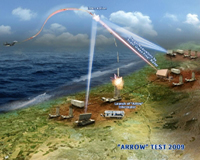
Israel and the United States on Thursday successfully tested a ballistic missile interceptor as the Jewish state seeks to upgrade its defences in the face of regional threats, officials said.
The trial from an Israeli test range involved the Arrow 3 interceptor, designed to shoot down missiles above the atmosphere, with Israel concerned over the potential for attacks from enemies including Iran.
A similar test a year ago failed, but Thursday's trial intercepted a ballistic missile target above the Mediterranean.
"This successful test is a major milestone in the development of the Arrow Weapon System and provides confidence in future Israeli capabilities to defeat the developing threats," Israel's defence ministry said.
"Additional Arrow-3 interceptor tests are planned in the future to demonstrate capability prior to becoming operational."
The Arrow project was first launched in 1988 as part of the then Star Wars programme under late US president Ronald Reagan that was abandoned in 1993.
Arrow 3, developed jointly between the United States and Israel, is intended to serve as Israel's uppermost missile interception system. Lower-altitude interception systems are either already deployed or close to being operational.
Partly financed by the United States, the Arrow system was developed and produced by Israeli Aerospace Industries in partnership with Boeing.
Israel strongly opposed a nuclear deal struck in July between Iran and major powers, arguing it would not block its regional rival's path to atomic weapons.
It also argues that the lifting of sanctions under the deal will allow Iran to further back and arm proxy militants in the region.
The United States said earlier this month it was conducting a "serious review" into reports that Iran carried out a new round of ballistic missile testing in violation of UN resolutions.
Lockheed Martin PAC-3 missile intercepts ballistic target in flight test
White Sands Missile Range, N.M. (UPI) Dec 10, 2015 –
Lockheed Martin completed its flight test of the Patriot Advanced Capability 3, or PAC-3, Missile Segment Enhancement missile as part of a U.S. Army-led evaluation at White Sands Missile Range, New Mexico.
The demonstration marked the third PAC-3 missile test since November. During the test, two PAC-3 MSE missiles were launched and intercepted an incoming target, with the first missile hitting the target, which Lockheed Martin said was planned.
Lockheed Martin Missiles and Fire Control vice president of PAC-3 programs Scott Arnold called the test a success, saying it is another strong demonstration of the weapon's capabilities.
"With enhanced capability and range, we anticipate these innovative interceptors will play an increasingly critical role in defending against evolving missile threats around the globe," Arnold said in a statement.
PAC-3 is a high-velocity interceptor, designed to defend against tactical ballistic missiles, cruise missiles and aircraft. According to Lockheed Martin, the missile increases the Patriot launcher's firepower by a factor of four. The company has manufactured over 2,000 units to date.
The PAC-3 MSE variant builds on the PAC-3 missile, featuring a dual-pulse solid-rocket motor, larger control fins, and upgraded support systems, effectively doubling the missile's range.
PAC-3 has been sold to 10 international customers.
