
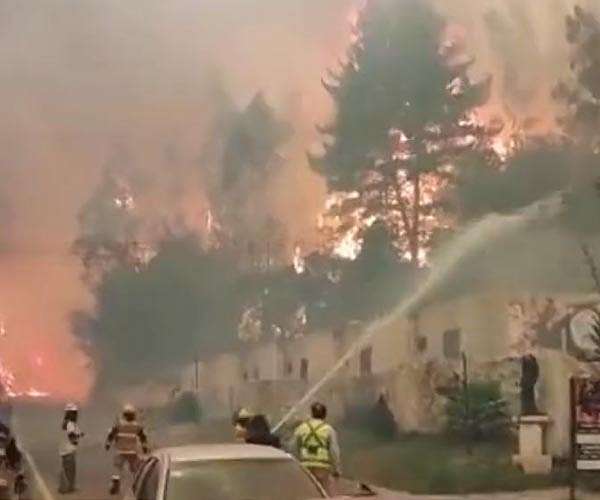
Rodrigo Pulgar was at home listening to news of the wildfires devastating parts of Chile when flames suddenly began rushing over his community.
"It was hell," the 61-year-old told AFP in El Olivar, what had been a peaceful, scenic area. "I tried to help my neighbor…(then) my house was starting to burn. Ash was raining down on us."
As a precaution, Pulgar had sprayed water on his wooden roof, which prevented the flames from consuming his home.
His neighbors in the community of 13,000 people were not so lucky — dozens of houses were reduced to blackened walls.
The majority of residents are "older people. And my neighbor died, because we couldn't get her out," Pulgar said.
El Olivar is just outside Vina del Mar, known for a music festival and its beaches, which was devastated by a wildfire Friday that killed dozens of people and left bodies in the streets.
Vina del Mar Mayor Macarena Ripamonti lamented that her city faces "an unprecedented catastrophe."
– 'Take care of my son' –
Anna Karina was working in a supermarket several kilometers from her home when she learned that El Olivar was burning.
Panic gripped her. Her 14-year-old son was home alone with their dog.
"The only thing I thought was that my son was dead, that my son was burned," she said.
Seized with anguish, she started walking toward home until managing to hop on a bus, which was then almost trapped by flames.
Once in her neighborhood, she had to cross a burning street. To her great relief, she found her son and dog outside their home, which was still standing.
"My father passed away last year and the only thing I was screaming for was for my father to take care of my son," Karina said.
Since 2017, Chile has been plagued by major forest fires.
This year they are driven by a heatwave and drought affecting the southern part of South America caused by the El Nino weather phenomenon, as scientists warn that a warming planet has increased the risk of natural disasters such as intense heat and fires.
Chile wildfires kill at least 46 in 'unprecedented catastrophe'
Vina Del Mar, Chile (AFP) Feb 3, 2024 –
Wildfires blazing across Chile have killed at least 46 people, officials said Saturday, leaving bodies in the street and homes gutted as flames continued to spread.
President Gabriel Boric has decreed a state of emergency in the central and southern parts of the country "due to catastrophe," as dry conditions and temperatures soaring to 40 degrees Celsius (104 degrees Fahrenheit) exacerbated the crisis.
"There are 40 people who were killed in the fire, and another six (who died) as a result of burns," Boric said, after he surveyed the affected region via helicopter Saturday afternoon.
"We know that these (numbers) will increase," he added.
After the flight he promised, "We will be there as a government to help them get back up (on their feet)."
Dense gray smoke blanketed the Vina del Mar area of the Valparaiso tourist region, along central Chile's coastline, forcing residents to flee their homes.
Authorities imposed a curfew beginning at 9 pm (0000 GMT) Saturday, to allow emergency supplies — especially fuel — into the affected areas. New evacuation orders were issued, though it remained unclear exactly how many people have been told to leave.
Earlier Saturday, Interior Minister Carolina Toha said there had been 92 fires as of noon, with 43,000 hectares (106,000 acres) burned across the country. Firefighters were still battling 29 of the blazes by the afternoon, while 40 had been brought under control.
In the hillsides around the coastal city of Vina del Mar, entire blocks of houses were burned out overnight, AFP reporters saw Saturday morning, as thousands of people who had previously evacuated returned to find their homes destroyed.
Some of the dead were seen lying in the road, covered by sheets.
The area, about 1.5 hours northwest of the capital Santiago, is a popular tourist destination during the summer months. The coastal region is also important for the country's wine, agricultural and logging industries.
In the towns of Estrella and Navidad, southwest of the capital, the fires burned nearly 30 homes, and forced evacuations near the surfing resort of Pichilemu.
"I've never seen anything like it," 63-year-old Yvonne Guzman told AFP. When the flames started to close in on her home in Quilpue, she fled with her elderly mother, only to be trapped in traffic for hours.
"It's very distressing, because we've evacuated the house but we can't move forward. There are all these people trying to get out and who can't move," she said.
Vina del Mar Mayor Macarena Ripamonti said, "We're facing an unprecedented catastrophe, a situation of this magnitude has never happened in the Valparaiso region."
– 'Extreme' –
Several thousand hectares have burned in Valparaiso alone, according to CONAF, the Chilean national forest authority.
Images from trapped motorists have gone viral online, showing mountains in flames at the end of the famous "Route 68," a road traveled by thousands of tourists to reach the Pacific coast.
In addition to Valparaiso, firefighters and emergency services personnel were battling blazes in the center and south of Chile, including O'Higgins, Maule, Biobio, La Araucania and Los Lagos.
"This was an inferno," Rodrigo Pulgar, who lost his home in the inland town of El Olivar, told AFP. "I tried to help my neighbor… my house was starting to burn behind us. It was raining ash."
On Friday, authorities closed the road linking Valparaiso to the capital Santiago, as a huge mushroom cloud of smoke "reduced visibility."
The fires are being driven by a summer heatwave and drought affecting the southern part of South America caused by the El Nino weather phenomenon, as scientists warn that a warming planet has increased the risk of natural disasters such as intense heat and fires.
As Chile and Colombia battle rising temperatures, the heatwave is also threatening to sweep over Paraguay and Brazil.
In Argentina, brigades from several provinces have been fighting a fire that has consumed more than 3,000 hectares in Los Alerces National Park, famed for its beauty and biodiversity, since January 25.
