
Italy's major risks commission cautioned Friday that there may be more powerful earthquakes to come following two this week in the country's mountainous centre and a deadly one in August.
"There is no current evidence that the (seismic) sequence underway is coming to an end," it warned.
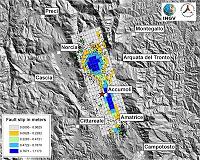
The National Commission for the Forecast and Prevention of Major Risks (CGR) said that in the wake of the August 24 quake that killed nearly 300 people it had identified three areas at risk for further seismic activity.
The areas were "adjoining the fault responsible" for the disaster which levelled entire villages, it said in a statement referring to the fracture in the earth's crust where quakes can occur.
They were areas "which have not seen recent, large earthquakes and could produce high-magnitude quakes (6-7)", it added.
Wednesday's quakes (5.5 and 6.1 magnitude) "activated one of the areas identified by the commission, to the north of the August quake, while the other two did not move," it said.
Those that did not move, both in the central Appenines, "represent possibile sources of future earthquakes in the region".
In particular, the commission said it "cannot rule out the continuation of seismic activity to the north of the Vettore-Bove," referring to Mount Vettore and Mount Bove on the border between the Umbria and Marche regions.
It described the earthquakes, which Wednesday brought down houses but left the local populations largely unscathed, to be typical of those in the Apennines, and warned history shows very strong quakes can follow each other here even months apart.
Ghost villages in quake-hit central Italy
Ussita, Italy (AFP) Oct 28, 2016 – The coloured houses and bustling squares of villages nestled in the mountains of the Marche region in central Italy were abandoned in a matter of hours as earthquake survivors fled.
As residents from Visso to Ussita and Castelsantagelo reeled from two powerful quakes on Wednesday and gazed in desolation at the collapsed buildings and cracked church towers, firemen ordered them to leave for security reasons.
Many in Ussita had already run from their homes as the first quake hit at 7:10pm, and were somewhere safe by the time the second, 6.1 magnitude quake, toppled walls at 9:18pm.
There have been nearly 700 aftershocks since then.
Those hoping to go back have to be escorted by firefighters: "We help one by one those who want to return home to recover personal items, essential things," fireman Michelangelo Garetti told AFP.
Locals line up to identify themselves and point out their houses. One man, Otello, said he wanted to recover "some valuables and also clothes for the winter, which promises to be long and hard".
While this is an area of lush green forests and valleys in bloom in the warm months, temperatures plunge once the snows fall.
"Few houses are safe and in any case we don't trust them. The ground has been 'dancing' under our feet in this small valley for the past two months," said the man, who is being put up by relatives in nearby Macerata.
– Wooden bungalows –
Ussita had already been shaken hard by a deadly nighttime earthquake on August 24 which hit a few dozen kilometers to the south.
Now locals are "either with relatives, or in hotels near the coast, or sleeping in campers," said Lara Manzoni, a 30-something resident who moved from Bergamo in the north of Italy a year ago to settle in Ussita.
Although she works for a frozen pizza company in a nearby village, she and hundreds of colleagues must wait for experts to verify to what extent the company's premises were damaged before she can return to work.
"I sent my children to my mother in Bergamo to keep them safe, but I could not see myself leaving all these people in trouble," she said.
Although the government has promised that all destroyed or damaged buildings will be rebuilt, "I do not know if I'll stay".
"I might leave the Marche region entirely, or buy a camper myself," she said.
In the meantime she is lending a hand at the village's campsite, which reopened out of season on Wednesday to accommodate some 250 quake survivors in its Alpine chalet-style wooden bungalows.
Some locals were lucky enough to already have their own, others have been lent chalets — bedding and all — by absent owners.
On a hill overlooking the site stands the village's once-prized attraction: a 15th century tower, now cracked from top to bottom.
