
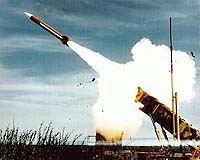
Japan on Monday reassured Moscow that an anti-missile shield planned with the US military was no threat to Russia and was aimed only at North Korea.
Japanese Foreign Minister Masahiko Komura told his Russian counterpart Sergei Lavrov in Moscow that the missile shield was needed in response to communist North Korea's missile and nuclear programmes.
"Concerning cooperation with the United States on an anti-missile defence system, it must be said that Japan's situation forced this on us," Komura told journalists. "It is in no way aimed at Russia."
Russia has expressed strong opposition to US anti-missile plans, particularly a system of 10 interceptors and a radar based in Poland and the Czech Republic.
Lavrov said Moscow "accepted the explanation" of Japan.
Russia would prefer however that Japan joined a global anti-missile system anchored around Russia, Europe and the United States, Lavrov said, because this would be "the best method for monitoring and where necessary neutralising the threat."
Last October, Komura told Lavrov in a meeting in Tokyo that Japan had no intention of backing off its anti-missile plans.
The United States has a security treaty under which it protects Japan, which has been officially pacifist since defeat in World War II.
Japan has had rocky relations with Russia. The two nations have never signed a treaty to formally end World War II due to a dispute over four islands off Japan's northern coast which Soviet troops seized in 1945.
earlier related report
Czechs seek US military aid in anti-missile radar deal: report
Prague called for US help to modernise its armed forces in return for its cooperation with Washington's anti-missile radar plan, a Czech minister told public television on Monday.
"We have asked the US for cooperation in the acquisition of two mid-range tactical transport plans and that should be raised in the framework of anti-missile defence negotiations," Martin Bartak told Czech Television.
The Czech request for military help would not form part of previous deals signed during the NATO summit in Budapest earlier this month, the broadcaster said.
It is the first time that the Czech government has detailed what they want in return for helping the United States with its controversial system.
Until now, Prague has only demanded research and technical cooperation with Washington as a sweetener for hosting the radar system.
The US says wants it to operate together with interceptor missiles in neighbouring Poland to defend against missile attacks from countries it regards as "rogue states" such as Iran.
Czech Prime Minister Mirek Topolanek even criticised Poland in March for having requested US help to modernise its army as part of its own anti-missile defence negotiations.
Russia has strongly opposed the installations, which would lie in what was the former Soviet Union's sphere of influence. Moscow is worried that the system could pose a threat to its own security.
The Czech Republic and US signed a diplomatic deal over the radar at the NATO summit in Bucharest.
Together with another accord over US soldiers sited at the base, it still has to be approved by the Czech parliament.
But Topolanek's centre-right coalition cannot be certain of winning a majority for the agreement.
