
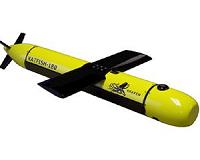
A towed sonar system is being supplied to Israel's Elbit Systems Ltd. by Kraken Sonar Inc. of Canada for use by a new unmanned surface vessel.
The towed sonar system is the Katfish, which produces ultra-high resolution seabed imagery with constant resolution to full range. It also delivers 3D bathymetry data that's co-registered and geo-referenced to the same pixel grid coordinates as the imagery.
The sonar system is operated through a laptop computer.
Details of the contract received by Kraken Sonar from Elbit Systems were not revealed but Kraken indicated it would be for use with Elbit's newest unmanned surface vessel, the Seagull.
Seagull is a multi-mission platform with modular features that allow it to be quickly reconfigured for a wide variety of missions, including anti-submarine warfare and mine counter-measures.
"Elbit's Seagull USV is one of the most advanced ocean drones in the world — one that will save lives," said Karl Kenny, president of Kraken Sonar. "When our Synthetic Aperture Sonar is integrated on Elbit's Seagull USV, the system can provide remotely operated, unmanned, end-to-end mine-hunting operations.
"These ocean drones can detect very small objects hidden on the seabed and enter confined spaces where underwater explosives are likely to be hidden. Since robotic systems can be remotely operated their use can remove people from very dangerous missions — in essence, taking the sailor out of the minefield."
Type 23 frigates getting communications upgrade from Thales
Paris (UPI) Feb 25, 2016 –
Thales has been contracted to perform a midlife communications system update to Royal Navy Type 23 frigates.
he U.K. Ministry of Defense award is worth more than $26.5 million.
Thales said the modernization it will perform involves replacing the analog External Communications Voice Distribution and Management System on the frigates with a fully digital system.
"This is a significant win for Thales as it builds upon our position with the Royal Navy as the leading supplier of naval communications products and services for the fleet," said Hervé Derrey, vice-president for Radio Communications Products at Thales. "The Thales Team has successfully developed an innovative and competitive solution, including unique approaches to integrating the system into the legacy platforms with minimal impact, always a key requirement of the customer."
The modernization is the first phase of the fleet-wide Project Calliope to progressively update the majority of terrestrial communications systems fitted across the Royal Navy surface fleet and some Royal Fleet Auxiliary platforms.
"I am pleased to be awarding the … contract to Thales — their design offers a compelling solution providing value for money through life," said Carolyn Bellars, the MOD's Defense Equipment & Support Maritime Combat Systems Communications and Situational Awareness Team Leader.
The replacement system "represents a significant improvement in technology terms and the Thales solution brings things right up to date."
The replacement of the systems will begin in the spring of 2017.
