
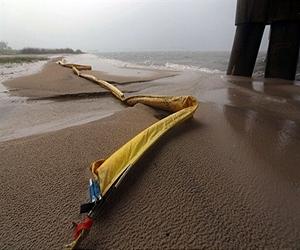
Louisiana begged for more protective booms and urged the federal government not to repeat the mistakes of Hurricane Katrina Friday as a massive oil slick lapped coastal islands.
More than two weeks after a BP-leased rig sank spectacularly 50 miles offshore and started hemorrhaging an estimated 200,000 gallons of oil a day into the Gulf of Mexico on April 22, vast swaths of the US coast remain unprotected.
High winds and rough seas bear some of the blame, but Governor Bobby Jindal said the problem now is a lack of the resources needed to avert disaster.
"We need more booms to keep this oil out of our fragile wetlands," Jindal said at a press conference in the remote port of Hopedale.
"It's so important to have those first lines of defense in place," he said.
"It'll be so much harder to clean up this oil if it's allowed to come into the inside and the backside of these wetlands."
Fishermen watching their livelihoods get washed away by a toxic soup are anxious to get their boats out the docks and help in efforts to skim the oil off the surface and lay out protective booms.
While a lucky few have gone out to help, most sit around waiting for the phone to ring.
Federal officials say they have a stockpile of 1.3 million feet of boom ready to be deployed across the Gulf Coast.
They shipped 20,000 feet to Hopedale on Friday, bringing the parish's total to 60,000 feet.
Local officials say they need at least another 240,000 feet of hard and absorbent boom to offer the "very minimal protection" to the parish's 120 miles of coastal wetlands.
And the oil sheen has already entered their waters.
"We cannot afford to let this turn into another catastrophe for St. Bernard parish," said parish president Craig Taffar.
"It's a community that is just getting back on its feet after Hurricane Katrina."
Taffar acknowledged that fighting the oil was a monumental task and that it will be impossible to protect every inch of his parish.
But he said the psychological impact of suffering through another disaster where the government failed to apply the proper resources is "unforgiveable."
"I'm not sure that their mental and psychological well-being will recover as well from this as we did from Katrina," he said. "You can only take so many blows before you fall down."
Taffer – whose parish stretches from this isolated port to the edge of the Lower Ninth Ward in New Orleans – said the current situation does not approach the complete failure of government after Hurricane Katrina struck on August 29, 2005.
Tens of thousands of people were stranded for days without food or water – some on their roofs, others at the Superdome stadium or on freeway overpasses – after a massive storm surge wiped out coastal towns and smashed through poorly-maintained levees.
The scars are still visible across the parish where abandoned homes rot in the hot sun, the spray painted markers left by search and rescue crews a stark reminder of those who died when the water rushed in.
This looming ecological and economic disaster evokes painful parallels to those chaotic days when desperate people were left to fend for themselves, Taffar said.
"It certainly has remnants of feeling helpless and having agencies and individuals in higher levels of authority controlling our destiny, and that is frightening," he said.
"We have our residents and fishermen here – they're standing here begging to be utilized to protect their own livelihood and the resources aren't here."
BP is financially responsible for all cleanup efforts, which are also being supervised by the US Coast Guard and a host of other agencies.
Some 10,000 people and about 270 boats have been deployed to the Gulf Coast to help combat the ever-growing slick.
There is no reason why more cannot get involved, Taffer said, or why resources are being spread out across the coast when Louisiana faces an "immediate threat."
"If there's boom headed to Alabama or Florida where there is not a direct threat we are asking the Coast Guard to bring them here," he said.
"We need the resources to protect our wetlands. We need the resources to protect our way of life. We need the resources to protect a culture- and a history-rich parish."
Share This Article With Planet Earth
