
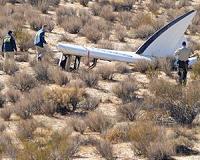
About three years ago the National Transportation Safety Board announced its finding regarding the Virgin Galactic crash that occurred on October 31, 2014. The simple explanation was that the co-pilot unlocked a critical vehicle mechanism too early. After a nine-month investigation the NTSB further concluded that human error and inadequate safety procedures caused the violent crash.
The vehicle was named the VSS Enterprise, or more precisely, Virgin Galactic/Scaled Composites Model 339 SpaceShipTwo experimental test vehicle. This spacecraft suffered a catastrophic in-flight breakup, followed by a crash in California's Mojave Desert. Fortunately, there were no passengers on board, because this was a test flight.
However, the co-pilot, Michael Alsbury, was killed and the pilot, Peter Siebold, was seriously injured. This was the fourth powered flight of a vehicle designed to complete suborbital flights by rocketing out of the atmosphere and coasting back to Earth after several minutes of weightlessness for commercial passengers. Today, Virgin Galactic is in final preparations for its first flight with passengers.
SpaceShipTwo was design to be released for a carrier aircraft, WhiteKnightTwo. Seconds after release an internal rocket ignites on SpaceShipTwo, propelling it toward the edge of the atmosphere. On the 2014 fatal test flight a new and more powerful hybrid rocker motor was being flight tested for the first time.
According to a public NTSB briefing, SpaceShipTwo dropped from the carrier aircraft and fired its rocket motor engine normally. However, about 11 seconds later, SpaceShipTwo violently broke apart, subsequently creating a 35-mile long debris field. Witnesses saw a parachute deploy before the aircraft crashed.
Typical of such a catastrophic event early speculation as to the cause involved the theory that the new rocket motor was at fault. However, this was almost immediately discarded when the rocket and its propellant tanks were recovered intact. As it turned out, cockpit video subsequently indicated that the feathering system, which acts as an air-braking descent device, was deployed too early.
In fact, just two seconds after the copilot unlocked the feathering system, while still accelerating under rocket power, the craft disintegrated. This was the first loss of life on a spacecraft in flight since the Space Shuttle disaster in 2003. This disaster further demonstrated the critical nature of many types of mechanisms used on space vehicles and the importance of establishing precise procedures for using such mechanisms.
Subsequent to the crash, FAA's Office of Commercial Space Transportation awarded Virgin Galactic an Operator License for SpaceShipTwo. This license will soon permit commercial operations. The second SpaceShipTwo was successfully test flown in 2017 and reach space for the first time on December 13, 2018.
This vehicle has been modified to correct the deficiencies related to the 2014 crash. When finally certified to carry passengers, SpaceShipTwo will carry up to six paying passengers and two pilots on short, suborbital flights. The seat price is $250,000 each.
