
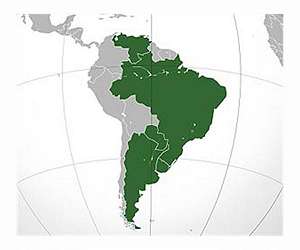
Latin American trade bloc Mercosur is aiming to forge a regional parliament likely to be more democratic than some of its constituent countries as it prepares to clinch a deal with the European Union.
The EU is Mercosur's ultimate model but the group has faced criticism that several of its member countries have yet to meet the criteria established when the regional trade pact came into force in 1991. Mercosur was founded by the Treaty of Asuncion and later upgraded by another treaty signed at Ouro Preto, Brazil.
Mercosur's founding members Argentina, Brazil, Paraguay and Uruguay have been joined by associate members that include Bolivia, Chile, Colombia, Ecuador and Peru. Venezuela joined as a full member but has yet to win formal entry.
Both critics and supporters say a more democratic framework for Mercosur would be "good to have" before an association and cooperation agreement with the EU is formalized early next year.
The revamped regional assembly, Parlasur, has set more ambitious targets for democratization than several of the constituent countries have appeared willing to allow for their national legislatures.
Nearly all the objectives of Mercosur mirror the EU's makeup. Unlike multilingual EU, Mercosur is content to work with only Portuguese and Spanish, the two dominant languages in Latin America.
The Mercosur region's total population of more than 270 million and a gross domestic product of $2.9 trillion makes it an attractive partner for the EU.
A political agreement now in place aims to introduce allocation of seats in Parlasur on the basis of proportional representation and direct universal vote. Both concepts are unfamiliar to some of the constituent countries.
Uruguayan Foreign Affairs Minister Luis Almagro, who announced the political accord after a meeting in Montevideo, the Uruguayan capital, said the agreement "among other things establishes proportional representation and the need for citizens' participation in the election of parliament members."
Parlasur has been meeting on and off since 2007 with representatives from founding members Argentina, Brazil, Paraguay and Uruguay elected by their peers in each of the national legislatures. The founding countries have 18 representatives each in Parlasur, which meets in Montevideo.
Once the agreement comes into force the regional legislature will have 37 representatives from Brazil, 26 from Argentina and 18 each from Paraguay and Uruguay, MercoPress reported.
By 2015, however, Parlasur will have 75 seats representing Brazil and 43 for Argentina, while Paraguay and Uruguay will each have the 18 seats they have at present. The disparity was explained by adherence to a proportional representation model that compared Brazil's population of 193 million and Uruguay's 3.3 million.
Already disagreements over the shift to proportional representation have appeared on the surface, especially in tiny Uruguay. And it is by no means clear if Argentina, already facing problems with democratic processes at home, will introduce timely legislation to get the switchover going.
An even more challenging task facing Mercosur will be giving Parlasur teeth. So far, Parlasur has demonstrated little political clout. However, Mercosur member countries are wary of empowering Parlasur at the expense of national government and policy making. Critics cite the example of European dissatisfaction over EU taking on joint foreign policy and defense roles.
Mercosur's talks with European Union are seen as an incentive to Latin American government leaders and legislators to follow the European model and try to make the most of opportunities offered by Parlasur.
The next round of Mercosur-EU talks is to take place in Brasilia in late November after transition of power from outgoing President Luiz Inacio Lula da Silva to a new president to emerge from the second round of voting. Lula protege and Workers Party representative Dilma Rousseff is favored to win.
earlier related report
EU hands award to Cuban dissident
Strasbourg, France (UPI) Oct 21, 2010 –
The European Parliament Thursday awarded its top human rights prize to Cuban dissident Guillermo Farinas, who has staged numerous hunger strikes to raise awareness about human rights abuses in Cuba.
Jerzy Buzek, the parliament's president, Thursday in Strasbourg said Farinas, 48, would receive the 2010 Sakharov Prize.
"Guillermo Farinas was ready to sacrifice and risk his own health and life as a means of pressure to achieve change in Cuba," Buzek said. "I hope to hand over the award to him in person, here in Strasbourg, in December, which would be a tremendous moment for the European Parliament and for all Cuban prisoners of conscience."
A proponent of non-violence, Farinas has staged numerous hunger strikes to fight against censorship and for more democracy in Cuba.
A former soldier, journalist and a doctor of psychology, Farinas ended a 134-day hunger strike in July after the Cuban government agreed to free more than 50 political prisoners.
European parliamentarians backing the nomination called Farinas's struggle "a shining example for all defenders of freedom and democracy."
Farinas Thursday said he was accepting the award with modesty.
"Modesty because it's a prize that, even if given to me personally, I accept it on behalf of all Cuba's exiles, political prisoners and dissidents. As I speak they are fighting for a free and democratic Cuba," Farinas told the Euronews Web portal by phone from his home in Santa Clara, Cuba, where he is recovering from his most recent hunger strike. Doctors said he was near death when he ended it.
Named after late Soviet dissident Andrei Sakharov, the award carries a cash prize of around $70,000.
It's the third time the award goes to Cuba. In 2002, it was awarded to the Ladies in White group of women who took the streets to protest for their jailed husbands. Three years later, the prize was handed to Cuban dissident Oswaldo Sardinas.
Buzek said he hoped that the Ladies in White would also be able to collect their Sakharov Prize in person this December; they haven't been allowed to leave the country since their nomination.
The most recent nomination comes shortly before EU foreign ministers are due to discuss relations with Cuba next week.
Brussels has in the past urged Cuba to improve its human rights record and relations with the country have been icy.
Spain, the holder of the rotating EU presidency, is eager to normalize relations with Cuba, but smaller countries in Eastern Europe that have suffered under Communist rule are against softening up to Cuba.
Share This Article With Planet Earth
