
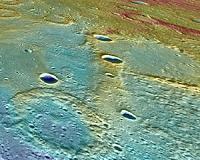
The Messenger spacecraft, which crash-landed into Mercury just a few days ago, found traces of magnetization in Mercury's crust, a new study reports.
The presence of residual magnetization provides insights into the planet's evolution. It suggests that a dynamo, driven by the electrically conductive molten iron at Mercury's core, generated a magnetic field 3.8 billion years ago.
As Mercury also has a magnetic field in operation today, the evidence for an ancient field suggests that Mercury's dynamo has persisted for billions of years.
On April 30, 2015, the Messenger spacecraft – the first to orbit Mercury – crashed into the enigmatic planet. Launched in 2004, Messenger had been in space for more than a decade. During the four years it orbited Mercury, Messenger provided vast amounts of data to scientists.
Now, using low-altitude satellite observations from the spacecraft, Catherine Johnson et al. report a weak magnetization signal that appears to emanate from an ancient region of Mercury's crust.
The finding that Mercury's core dynamo field was present early in the planet's history provides important insight into the evolution of the planet's core and the dynamo action within it.
