
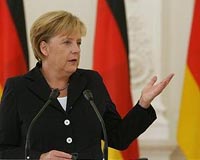
Chancellor Angela Merkel's government Wednesday pledged a new climate strategy by September as it scrambles to tackle what has become Germany's hottest political issue.
Merkel's coalition took heavy losses in Sunday's European Parliament elections at the hands of the ascendant Greens in what was seen as an indictment of Berlin's plodding progress on tackling global warming.
Young voters in particular — energised by the Fridays for Future school strikes, anti-coal protests and a passionate campaign from leading YouTube stars — abandoned the mainstream CDU/CSU and SPD parties in droves.
Environmental groups demand that Germany fast-forward its phasing out of dirty coal, currently targeted for 2038, and better promote zero-emission cars that remain a rare sight on German roads.
Merkel, who acknowledged on CNN that "we have to give better answers" to the planetary challenge, met ministers of her "climate cabinet" Wednesday to discuss how Germany should meet its carbon reduction targets.
Afterwards, Merkel's office reaffirmed Germany's intention "to meet the 2030 climate targets to which it has committed itself internationally" — a 55- percent cut in emissions from 1990 levels.
"This means significant additional CO2 reductions year after year," said her spokesman Steffen Seibert, stressing that Merkel's government "sees this as a key focus of its work".
"The government will in September make the fundamental decisions on the laws and measures and the cabinet will adopt them by the end of the year," he added.
– 'Climate chancellor' –
The far-right AfD party has also come under fire from its youth wing for its scepticism about climate change.
In an open letter, the youth wing urged party leaders to admit that "man influences the climate" and that asserting otherwise was "difficult to understand."
Germany long earned plaudits as a clean energy pioneer, and Merkel was dubbed the "climate chancellor", for pushing renewables while committing to phase out nuclear power by 2022 and now coal by 2038.
However, green activists now feel that progress has stalled and demand a far earlier end to coal and the combustion engine, as well as dramatic shifts in transport, agriculture and other fields.
Germany is now set to miss its 2020 target of cutting CO2 emissions by 40 percent from 1990 levels. It is currently on course for only a 32-percent reduction.
Since the European election, criticism has been raining down from all sides, not just environmental groups.
Friedrich Merz, a conservative former investment fund boss with designs on Merkel's job, charged that "the CDU must ask itself why, after 14 years of having a 'climate chancellor', we are missing our climate targets, burdening households and companies with the highest electricity prices in Europe and at the same time losing strategic and cultural control over the issue."
The poor poll result has also heightened tensions between the two uneasy coalition allies.
A day after the ballot box drubbing, the SPD Environment Minister Svenja Schulze voiced her frustration about the CDU's foot-dragging on her climate bill, saying that she could not "take responsibility for further delays."
– 'Sabotage' –
The Greens' politician Cem Ozdemir held out special criticism for Transport Minister Andreas Scheuer of Bavaria's conservative CSU party, saying that so far he had "sabotaged any serious climate policy".
Scheuer said in a statement that his philosophical approach was to "allow, facilitate and enable — not to prohibit, demonise and raise costs".
The pressure group also believes Germany must shutter seven coal plants by 2022 and completely phase out the polluting energy source by 2030.
And Kaiser demanded a shift away from "industrial agriculture" and toward organic farming.
Germany's new climate law will look at the energy sector, housing, transport, industry, agriculture and forestry, and waste management, government spokesman Seibert said.
It will also address "CO2 pricing" to factor in the economic cost of emissions, which can take the form of a carbon tax or trading of emissions certificates.
In one fresh proposal, Housing Minister Horst Seehofer on Wednesday suggested tax deductions for green building renovations, such as insulating walls and roofs and replacing old heating systems.
bur-fz/hmn/spm
