
Scientists have known the moon once hosted dozens of volcanos and oozing magmatic vents. More recently, researchers credited this ancient volcanic activity with forming the lunar feature known as the man in the moon.
Despite that revelation, it was generally agreed that the moon cooled and magma stopped rising to the surface at least one billion years ago. New research has undermined that assumption. In a new study, a team of geologists at Arizona State University's School of Earth and Space Exploration posit that the moon has hosted small but widespread volcanic eruptions during the last 50 million years.
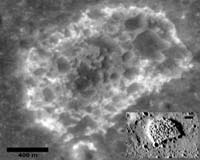
The scientists' proof: as many as 70 small and mostly unstudied geologic features they say were produced by leaking basaltic lava. The features — unassuming low, rounded mounds among contained splotches of rough, blocky terrain — aren't visible from Earth, but they've been detailed by more recent surveys of the moon's surface. The scientists refer to these features as "irregular mare patches."
"Finding previously unknown geologic features on the lunar surface is extremely exciting," lead study author Sarah Braden said in a press release. "The existence and young age of the irregular mare patches provides a new constraint for models of the lunar interior's thermal evolution," she added. "The lunar mantle had to remain hot enough for long enough to provide magma for the small-volume eruptions."
The study — published this week in the journal Nature Geoscience — and its revelations may inspire scientists to rethink their best estimates for the current internal temperature of the moon's core. At the very least, it will provide the next lunar rover with some exciting new mission objectives.
"Our understanding of the moon is drastically changed by the evidence for volcanic eruptions at ages much younger than previously thought possible, and in multiple locations across the lunar maria," Braden concluded.
