
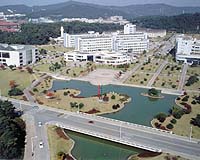
NASA's Ames Research Center and the Korea Advanced Institute of Science and Technology, (KAIST) South Korea's premier research and education institution, signed a memorandum for the record on Jan. 26, 2008, an important milestone in a new relationship under development.
Ames' Director S. Pete Worden and KAIST President Nam Pyo Suh have now agreed to initiate technical discussions on specific areas of potential collaboration involving small satellite research and development.
These potential areas for future collaboration include satellite communication, navigation systems, planetary exploration, lunar science, rovers, small satellites and related technologies.
"We are exploring a new partnership with South Korea in future satellite research and development," said Worden.
"We are looking forward to working with the Korea Advanced Institute of Science and Technology to advance future space exploration," Worden added.
"I am delighted with this outcome. This potential collaboration is a historic event for KAIST as well as for NASA Ames," said Suh.
KAIST's research team, led by professor Soon-dal Choie, launched Korea's first small satellite 'Uribyeol 1' in 1992.
Since then, Korea has launched 10 small satellites. The most advanced of these, Arirang 2, began operations in July 2006, and can distinguish objects as small as 39.37 inches (one meter) wide on Earth's surface.
