
Late last week, NASA announced that senior officials in charge of the manned space mission portfolio had been reshuffled amid growing impatience from President Donald Trump to hasten the return human beings to the lunar surface.
NASA Administrator Jim Bridenstine has explained why the US suspended its manned lunar program over 40 years ago and what it will take for the US manned space program to move forward.
"There's technical risk and then there's political risk. We would be on the Moon right now if it weren't for the political risk. We would be on Mars, quite frankly, by now, had it not been for the political risk," Bridenstine said, speaking to CBS News.
"I'm talking about funding," the administrator clarified, saying Moon programs of decades past were made infeasible by their length and expense. "In the past, in the 1990s and the early 2000s we made efforts to go back to the Moon and on to Mars, but in each case, the program was too long and cost too much money," he said.
Now, he noted, President Trump has sought to accelerate the program "in order to retire the political risk."
Asked to comment on NASA's Artemis program, which seeks to create a new heavy rocket, space capsule and lunar lander for a new Moon mission just five years from now, Bridenstine said President Trump's goal was broader.
"So we want to go back to the Moon sustainably, in other words, to stay. But we also want to keep our eye on what is President Trump's goal? What is his vision? He wants to put an American flag on Mars," Bridenstine said.
"So we go to the Moon, so that we can learn how to live and work on another world and, ultimately, have more access to the solar system than ever before so that we can get, no kidding, to Mars," the administrator added.
In March, Vice President Mike Pence called on NASA to hasten its efforts to prepare the components necessary to put people back on the lunar surface, and hinted that the agency would have to be reorganized if it couldn't handle the task of "landing American astronauts on the Moon in five years."
Late last week, NASA announced a leadership reshuffle, naming former astronaut Kenneth Bowersox as new acting associate administrator of the human exploration programme amid apparent dissatisfaction with the pace of progress.
Earlier this year, Bridenstine warned that the new $12 billion Space Launch System (SLS) super heavy rocket program under development by Boeing since 2011 is continuing to fall behind amid major cost overruns. The Orion crew vehicle, a US-European spacecraft designed to carry up to four astronauts into space, has faced similar problems, with the Government Accountability Office recently complaining about persistent delays and costs associated with the program, which has been engaged in testing since 2014. The new manned lunar lander for Moon Shot 2.0 has yet to even be designed, according to CBS.
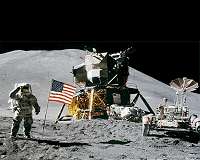
In December 1972, astronauts from NASA's Apollo 17 mission blasted off from the Moon and returned to Earth, with the mission becoming the last time humans would travel beyond low Earth orbit to another astronomical body in our solar system.
– SPACE STORY –
spacetravel
https://sputniknews.com/world/201907161076260418-india-china-join-forces-space-new-advances/
295
25-DEC-49
India, China should join forces in space to reach new advances as Russia, Washington did
India, China should join forces in space to reach new advances as Russia, Washington did
india-china-flag-hg.jpg
india-china-flag-lg.jpg
india-china-flag-bg.jpg
india-china-flag-sm.jpg
file image
International Space News at SpaceDaily.com
by Staff Writers
Washington DC (Sputnik) Jul 17, 2019
Friendly competition between India and China in space may generate technological advances and ultimately push spacefaring nations to join forces in new endeavours, as has been the case with Washington and Moscow, Rod Pyle, a space author and historian who has worked with NASA, told Sputnik.
"While there is always an urgency to fly on time, and while there is also what some might call a 'friendly rivalry' between India and China in terms of space accomplishments, it cannot compare to the white-hot rivalry between the United States and the Soviet Union in the 1950s and 1960s. And yet, what came of that rivalry were incredible technological advances on both sides, and ultimately cooperation in spaceflight," Pyle said.
In particular, Pyle pointed to India as a potential candidate to join other space nations that have flown humans into space.
"I have long been impressed with the advances of India in both robotic and human spaceflight. Their first mission to Mars, the Mars Orbiter Mission, flew in 2014, and they were successful on that first attempt – robotic Mars missions have a roughly 50 percent failure rate. Their lunar missions have also been impressive and performed at a far lower price than equivalent programs in the West. And, of course, they plan to fly humans into space within two years," he noted.
According to the expert, India's latest launch delay, even though not heartening, is no critical since "it is far better to launch late than to lose a rocket."
"Both the USA and Russia have been flying large rockets since the 1950s, and both nations still experience launch delays and failures from time to time. I did note that the delay of Chandrayaan 2 was attributed to the launch vehicle and not to a fault in the probe itself, so that's presumably something that the engineers will be able to fix in short order on the GSLV booster," Pyle pointed out.
He expressed confidence that the Indian Space Research Organisation would ultimately launch the mission when it would be ready and certain that "it has the best chance to succeed."
In general, he reiterated that "it's gratifying to see other nations such as India and China joining the human spaceflight 'club.'"
"I join Buzz Aldrin [US astronaut who became the second human to land on the Moon during the Apollo 11 mission] in the hope that the prominent spacefaring nations can one day soon join forces to take humans back to the moon and on to Mars in peaceful cooperation," he concluded.
The interview came soon after India called off the much-anticipated launch of its Chandrayaan-2 lunar mission less than an hour before the scheduled liftoff on Monday due to what it said was a "technical snag." India has long been seeking to become the fourth nation, along with the United States, Russia and China, to land on the Moon, but the historic mission has been suffering delays since April 2018.
Despite the latest incident, the expert highly assessed India's ambitious space program, expressing the belief that the "friendly" competition in space will only facilitate new breakthrough in space explorations and ultimately encourage cooperation.
Space has indeed been an area of not only permanent rivalry but also cooperation, with Russian-made spaceships Soyuz used to deliver US astronauts to the International Space Station and Russian-built RD-180 engines powering the first stage of the only US vehicle capable of sending heavy payloads being among such examples.
