
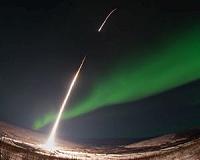
On March 3, 2014, at 6:09 a.m. EST, a NASA-funded sounding rocket launched straight into an aurora over Venetie, Alaska. The Ground-to-Rocket Electrodynamics – Electron Correlative Experiment, or GREECE, sounding rocket mission, which launched from Poker Flat Research Range in Poker Flat, Alaska, will study classic curls in the aurora in the night sky.
"The conditions were optimal," said Marilia Samara, principal investigator for the mission at Southwest Research Institute in San Antonio, Texas. "We can't wait to dig into the data."
Samara is the principal investigator for the NASA-funded Ground-to-Rocket Electrodynamics-Electrons Correlative Experiment, or GREECE, mission, which seeks to understand what combination of events sets up these auroral curls as they're called, in the charged, heated gas – or plasma – where aurorae form.
This is a piece of information, which in turn, helps paint a picture of the sun-Earth connection and how energy and particles from the sun interact with Earth's own magnetic system, the magnetosphere.
"Our overarching goal is to study the transfer of energy from the sun to Earth," said Samara, a space scientist at the Southwest Research Institute, or SwRI, in San Antonio, Texas. "We target a particular manifestation of that connection: the aurora."
At their simplest, aurorae are caused when particles from the sun funnel over to Earth's night side, generate electric currents, and trigger a shower of particles that strike oxygen and nitrogen some 60 to 200 miles up in Earth's atmosphere, releasing a flash of light.
But the details are always more complicated, of course. Researchers wish to understand the aurora, and movement of plasma in general, at much smaller scales including such things as how different structures are formed there.
To study the structures, GREECE consists of two parts: ground-based imagers to track the aurora from the ground and the rocket to take measurements from the middle of the aurora itself.
The rocket will fly for 600 seconds, reaching its zenith over the native village of Venetie, Alaska. State-of-the-art imagers will be placed in Venetie to watch the development of the curls and help the team decide when to launch – sometime during a launch window of Jan. 24 to Feb 6. Instruments on the rocket will gather information on the particles and electric fields within the aurora, which can be compared to the images gathered from the ground.
"Auroral curls are visible from the ground with high-resolution imaging," said Samara. "And we can infer from those observations what's happening farther out. But to truly understand the physics we need to take measurements in the aurora itself."
Different combinations of information on the particles and fields observed in the aurora, would point to a different cause for these swirls in the sky. Auroral curls might, perhaps, be caused by what's called a Kelvin-Helmholtz instability, the same combination of low and high speed flows that lead to surfer waves near the beach.
Or they could be caused by something called Alfven waves – a type of electromagnetic wave present only in plasmas. Or they could be caused by something else altogether.
Sounding rockets are a perfect tool for tackling the answer. For one thing, sounding rockets are one of the few space-faring vehicles capable of being sent directly through the heights at which auroras exist. Second, sounding rockets can provide a robust set of observations, even in a ten-minute trip, at relatively low-cost.
