
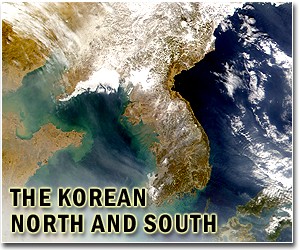
North Korea, after its artillery attack on the South this week, warned Friday that plans for a US-South Korean naval exercise bring the peninsula "closer to the brink of war".
The hardline communist regime on Tuesday fired shells and rockets at the South Korean island of Yeonpyeong, killing four people. It later claimed it was retaliating after South Korea had staged military exercises.
The USS George Washington carrier strike group, based in Japan, was Friday heading for waters west of the Korean peninsula where the US and South Korea plan four days of naval exercises in the Yellow Sea from Sunday.
US Forces Korea said in a statement Wednesday the drill had been planned well before North Korea's "unprovoked artillery attack" but it demonstrated the US "commitment to regional stability through deterrence".
Pyongyang's state-run Korean Central News Agency, in an article Friday on the planned war games, attacked "the US imperialists and south Korean puppet war-like forces" for what it called an exercise in "sabre-rattling".
"The situation on the Korean Peninsula is inching closer to the brink of war due to the reckless plan of those trigger-happy elements to stage again the war exercises targeted against the DPRK," it said, using the country's official name, the Democratic People's Republic of Korea.
US Forces Korea said in its statement Wednesday that the exercise is defensive in nature.
"While planned well before yesterday's unprovoked artillery attack, it demonstrates the strength of the Republic of South Korea-US alliance and our commitment to regional stability through deterrence," it said.
"It is also designed to improve our military interoperability."
The statement said that the US Navy "routinely operates in the waters off the Korean peninsula and has conducted numerous operations and exercises in this area."
North Korea's key ally China said Thursday it opposed the US-South Korea war games.
"We have taken note of relevant reports and express concern," foreign ministry spokesman Hong Lei told reporters when asked about the exercises.
"We oppose any act that undermines peace and stability on the peninsula."
China has previously come out strongly against such exercises in what it sees as its backyard, saying they risk exacerbating tensions.
earlier related report
UN rights envoy warns N.Korea further isolating itself
Seoul (AFP) Nov 26, 2010 –
The UN human rights envoy for North Korea warned Friday that the regime, which attacked a South Korean island this week, is isolating itself at a time when it badly needs humanitarian aid.
Marzuki Darusman was on his first mission to South Korea since taking the post this year but, like his predecessor, was denied entry to the country formally known as the Democratic People's Republic of Korea (DPRK).
"The DPRK should not find itself in isolation at a juncture when it needs the support and cooperation of the international community the most, both to address the human rights situation and the humanitarian needs," he said.
Darusman was speaking days after the volatile regime fired a deadly barrage of shells and rockets at a South Korean island near the disputed sea border, claiming it had acted in retaliation for a military exercise being staged there.
The UN envoy noted that, after devastating floods hit the North in August, South Korea had offered 5,000 tons of rice and 250,000 bags of cement in humanitarian aid for victims in the impoverished country.
All such aid shipments have been frozen since the North launched its strike on the island of Yeonpyeong, which killed two marines and two civilians and wounded 18 other people.
It was the first shelling of civilians since the 1950-53 Korean War.
Darusman said that despite the outbreak of hostilities, "it is important to continue to provide such humanitarian assistance", while ensuring that all aid distribution "reaches the neediest population".
He said hardship in North Korea had driven 20,000 people to flee to the South — including a record 2,027 arrivals last year — on journeys during which many fall victim to people-traffickers and sexual abuse.
After meeting with some asylum-seekers, 77 percent of whom are women, at a support centre, Darusman said he had learnt of the "harrowing experiences" they had endured both inside the North and on their journeys.
"I could see that the scars, such as post-traumatic stress disorders, run deep," he said. "They fear that the families of those who flee the country are being identified in the DPRK and face the prospect of harsh prison sentences."
Darusman also called on all countries which North Koreans use on their escape routes to protect the asylum-seekers and treat them humanely.
Most refugees pass through China — which has a policy of sending those who are caught back to the North — before they head for Southeast Asia and try to reach embassies of countries sympathetic to their plight.
The UN envoy, a former Indonesian attorney general, also highlighted the impact of the heightened tensions on a programme to allow families divided by the war on both sides of the peninsula to temporarily reunite.
"It is regrettable that that the talks between the Red Cross organisations of the two sides for further reunions have been put on hold in the wake of the recent artillery firing," said Darusman at a Seoul press conference.
"The number of persons affected by separation of families is so large that there is a need for a more frequent and regular family reunion… The majority of such separated members are now very old and some are already dead."
Share This Article With Planet Earth
