
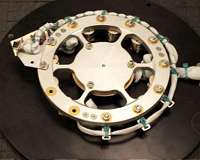
NanoRacks successfully deployed NovaWurks' SIMPL satellite via the Company's Kaber Microsatellite Deployer (KABER) from the International Space Station (ISS) early this morning. This is the second Kaber-class deployment that NanoRacks completed this week.
SIMPL went beyond standard satellite deployment from the Space Station. For this program, NovaWurks Inc. pioneered the Hyper-Integrated Satlet (HISat) technology, a concept to assemble larger satellites from small independent "cells" called satlets. Specifically, SIMPL was delivered to the ISS via NanoRacks in a few larger groups, and then assembled this week by the astronaut crew utilizing some smaller components.
"This was far more than just another satellite deployment for us here at NanoRacks," says NanoRacks External Payloads Manager, Conor Brown.
"For the first time ever a complex satellite was assembled on orbit from multiple satlets launched as separate spacecraft. Thanks to the innovative work of the NovaWurks team and the incredible coordination between our Operations team, NASA, and the ISS crew, we were able to achieve a major milestone towards the future of human and robotic manufacturing of satellites on orbit."
"These NovaWurks satlets can also be combined to form larger satellites or satellite constellations that share power, data, and other resources to perform different tasks.
"Thank you to NASA and the Space Station Program Office for their support in this unique technology demonstration and use of the astronaut crew skill set."
NanoRacks Kaber Deployment Program allows for a larger EXPRESS class of satellites to be deployed from the International Space Station, up to 100 kilograms.
NanoRacks deploys these Kaber-class satellites currently through the Japanese Experiment Module Airlock, and will shift deployments to the NanoRacks Airlock Module when the Company's commercial Airlock becomes operational (planned for 2019).
To learn more about the SIMPL mission visit here
Pope asks spacemen life's big questions in ISS live chat
Pope Francis chatted with six astronauts at the International Space Station (ISS) on Thursday, kicking off the rare interview with a philosophical question on "man's place in the universe".
Italian Paolo Nespoli, 60, admitted that despite the bird's eye view of Earth he too remained "perplexed", while American Mark Vande Hei said seeing the planet from space made them "realise how fragile we … read more
