
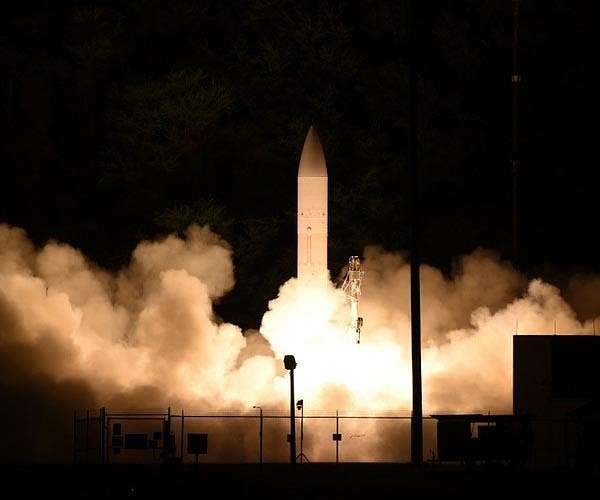
The Navy has successfully tested a second stage hypersonic rocket motor, the branch said Thursday.
Navy Strategic Systems Programs successfully conducted the initial live-fire test of the second stage Solid Rocket Motor on Wednesday, in Promontory, Utah, the Navy SSP said in a statement.
The test was done as a step toward developing a common hypersonic missile for the Army and Navy.
The second stage SRM will be combined with a Common Hypersonic Glide Body to create the common hypersonic missile, which will be tailored for use from sea or land, according to Navy officials.
The second stage test follows a successful live-fire test of the first stage solid rocket conducted in the same location in May.
The successful second stage test was "a critical milestone," according to the Navy SSP statement, ahead of Navy and Army joint flight tests and fielding of the Navy's Conventional Prompt Strike offensive hypersonic strike capability and the Army's Long Range Hypersonic Weapon.
The Navy is the lead designer of the CHGB and the Army is the lead producer of the CHGB, which the Department of Defense successfully tested on March 20, 2020.
"The Department of Defense is working in collaboration with industry, government national laboratories and academia to field hypersonic warfighting capability in the early-to mid 2020s," the Navy statement said.
In June, the Defense Department said the development of hypersonic missiles is accelerating, and it is staying within its $6.6 billion budget for the weapons program.
The U.S. Air Force's first hypersonic rocket booster test in April failed to launch.
In July, the U.S. Air Force successfully detonated a hypersonic missile warhead for the first time, but in a test later in the month the hypersonic booster rocket successfully released from an aircraft but failed to ignite.
Still, the U.S. Air Force said in early August it's hopeful that it will begin production of the hypersonic missile by the end of fiscal year 2022.
"Hypersonic weapons, capable of flying at speeds greater than five times the speed of sound — Mach 5 — are highly maneuverable and operate at varying altitudes," the Navy said in Thursday's press release.
"In a matter of minutes, Navy and Army warfighters can defeat high-value targets hundreds or even thousands of miles away. Delivering hypersonic weapons is one of the DoD's highest priorities," the Navy said.
