
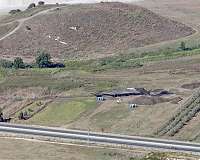
The archaeological site of 'Ein Qashish in northern Israel was a place of repeated Neanderthal occupation and use during the Middle Paleolithic, according to a study released June 26, 2019 in the open-access journal PLOS ONE by Ravid Ekshtain of the Hebrew University of Jerusalem and colleagues.
In the Levant region of the Middle East, the main source of information on Middle Paleolithic human occupation comes from cave sites. Compared to open air settlements, sheltered sites like caves were easily recognized and often visited, and therefore are more likely to record long periods of occupation.
The open-air site of 'Ein Qashish in northern Israel, however, is unusual in having been inhabited over an extended prehistoric time period. This site provides a unique opportunity to explore an open-air locality across a large landscape and over a long period ranging between 71,000 and 54,000 years ago.
In a joint collaboration with the Israel Antiquities Authority Ekshtain and colleagues identified human skeletal remains in 'Ein Qashish as Neanderthal and observed more than 12,000 artifacts from four different depositional units in the same location on the landscape. These units represent different instances of occupation during changing environmental conditions.
From modification of artifacts and animal bones at the site, the authors infer that the occupants were knapping tools, provisioning resources, and consuming animals on-site.
Whereas many open-air settlements are thought to be short-lived and chosen for specialized tasks, 'Ein Qashish appears to be the site of repeated occupations each of which hosted a range of general activities, indicating a stable and consistent settlement system. The authors suggest that within a complex settlement system, open-air sites may have been more important for prehistoric humans than previously thought.
Ekshtain adds: "Ein Qashish is a 70-60 thousand years open-air site, with a series of stratified human occupations in a dynamic flood plain environment. The site stands out in the extensive excavated area and some unique finds for an open-air context, from which we deduce the diversity of human activities on the landscape.
"In contrast to other known open-air sites, the locality was not used for task-specific activities but rather served time and again as a habitation location. The stratigraphy, dates and finds from the site allow a reconstruction of a robust settlement system of the late Neanderthals in northern Israel slightly before their disappearance from the regional record, raising questions about the reasons for their disappearance and about their interactions with contemporaneous modern humans."
Max Planck Institute for Evolutionary Anthropology
The ancient history of Neandertals in Europe
Leipzig, Germany (SPX) Jul 01 – Researchers at the Max Planck Institute for Evolutionary Anthropology in Leipzig, Germany, have retrieved nuclear genome sequences from the femur of a male Neandertal discovered in 1937 in Hohlenstein-Stadel Cave, Germany, and from the maxillary bone of a Neandertal girl found in 1993 in Scladina Cave, Belgium. Both Neandertals lived around 120,000 years ago, and therefore predate most of the Neandertals whose genomes have been sequenced to date.
By examining the nuclear genomes of these two individuals, the researchers could show that these early Neandertals in Western Europe were more closely related to the last Neandertals who lived in the same region as much as 80,000 years later, than they were to contemporaneous Neandertals living in Siberia.
"The result is truly extraordinary and a stark contrast to the turbulent history of replacements, large-scale admixtures and extinctions that is seen in modern human history", says Kay Prufer who supervised the study.
Intriguingly, unlike the nuclear genome, the mitochondrial genome of the Neandertal from Hohlenstein-Stadel Cave in Germany is quite different from that of later Neandertals – a previous report showed that more than 70 mutations distinguish it from the mitochondrial genomes of other Neandertals. T
he researchers suggest that early European Neandertals may have inherited DNA from a yet undescribed population. "This unknown population could represent an isolated Neandertal population yet to be discovered, or may be from a potentially larger population in Africa related to modern humans", explains Stephane Peyregne who led the analysis.
Research Report: Persistent Neanderthal occupation of the open-air site of 'Ein Qashish, Israel
