
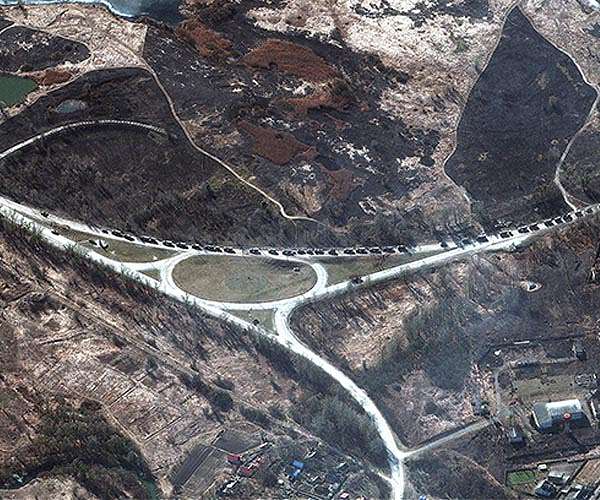
Russia has committed nearly all its combat power stationed along the border into Ukraine, the Pentagon said Monday as it announced 500 more US troops were deploying to Europe to boost NATO security.
With President Vladimir Putin intensifying operations, the US Defense Department also warned that Russian strikes on civilians were mounting and that Moscow was seeking to recruit foreign fighters, notably Syrians, for the war.
But the deadly invasion has slowed to a slog, and apart from some wins in southern Ukraine, Russian forces "really haven't made any noteworthy progress in the last few days," Pentagon spokesman John Kirby said.
The United States has already deployed 12,000 additional soldiers to Europe since February, but President Joe Biden has stressed that US troops will not engage in a conflict with Russian forces in Ukraine.
Over the weekend, Secretary of Defense Lloyd Austin ordered roughly 500 additional military personnel to locations in Europe, particularly NATO's eastern flank, "to augment US forces that are already in theater," Kirby told reporters.
"These additional personnel are being positioned to respond obviously to the current security environment caused by Russia's unprovoked invasion of Ukraine, and certainly to help reinforce and bolster deterrence and defense capabilities of the NATO alliance."
Kirby said the Defense Department has assessed that of the Russian forces built up along the border — estimated by Western nations at over 150,000 troops — Putin has "got nearly all the mass combat power that he had assembled inside Ukraine."
With Ukrainians trying to hold the assault at bay, Russia has engaged in more long-range attacks — a mix of bombardments, rocket launches, artillery strikes and more than 625 missiles — to make up for their lack of movement on the ground, the Pentagon said.
"We do believe… that they are having morale problems, they are having supply problems, they are having fuel problems, they're having food problems," he added.
"They're meeting a very stiff and determined Ukrainian resistance."
Bombardments have increased around the capital Kyiv, Kharkiv, Chernihiv in the north, and Mykolaiv and Mariupol in the south, and they "are having an increased effect on civilian casualties" and destroying homes, churches, hospitals and schools, Kirby said.
"The bottom line is, more civilians are being killed and wounded," he added.
"And Mr. Putin still has a choice here: Not to escalate… but to find a diplomatic path forward and end the invasion."
With enormous firepower at Putin's disposal, the Pentagon said it was noteworthy but nevertheless unclear why he would find it necessary to bring in foreign fighters.
"We know that they're trying to recruit Syrians for the fight," a senior US defense official said.
Meanwhile concern has grown that Odessa, the country's main port and a crucial economic hub, is in Russia's sights.
Ukrainian President Volodymyr Zelensky warned Sunday that Moscow was "preparing to bomb Odessa."
But the US official said the Pentagon has "not seen any evidence of a movement on Odessa" yet.
US says may become harder to ship arms to Ukraine
Madrid (AFP) March 7, 2022 –
Western nations have so far been succesful in delivering arms to Ukraine, but this may become harder in the coming days, US Deputy Secretary of State Wendy Sherman said Monday.
"I think it has been extraordinary the amount of arms supplies that are getting in to Ukraine even under the most difficult of circumstances," she told a media briefing in Madrid.
"The international community has been tremendously responsive and has found ways to get the material in. That may become harder in the coming days and we will have to find other ways to manage this," she said without elaborating.
Weapons, ammunition and funds have poured into Ukraine from Western allies since Russia invaded the country on February 24.
The United States last month authorised $350 million of military equipment — the largest such package in US history — to help the Ukrainian government fight off the invasion.
The European Union, meanwhile, has agreed to finance the purchase and delivery of arms to Ukraine totalling 450 million euros ($500 million).
Kyiv has urged the West to boost its military assistance to the besieged country, including warplanes, with President Volodymyr Zelensky pleading for Eastern European neighbours to provide Russian-made planes that his pilots are trained to fly.
"It is critical that what we send in is what President Zelensky asks for, because he knows what his military needs most," said Sherman, who is on a week-long trip to Turkey, Spain and North Africa.
