
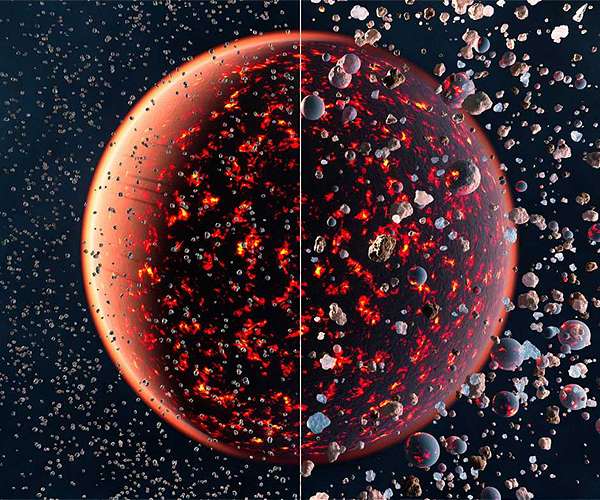
Age data from specific meteorite classes have unveiled new insights into the origin of water-rich small astronomical bodies, or planetesimals, in the early solar system. These planetesimals provided essential building materials for planets, including Earth, which initially had little water. Earth's water supply came from planetesimals formed at low temperatures in the outer solar system, where solid-state water ice was present, unlike the hotter, earlier-formed bodies closer to the sun. International research, involving Heidelberg University's earth scientists, used computational models based on these age data to trace the thermal evolution of these parent bodies.
Planets in our solar system formed concurrently with their mother star, with Earth emerging around 4.5 billion years ago in the sun's habitable zone, allowing liquid water on its surface. Like other planets, Earth grew from planetesimals formed when dust particles accumulated in high-pressure zones, collapsing under their own gravity. "These small bodies did not just supply the building materials for the planets," explained Prof. Dr. Mario Trieloff, director of the Klaus Tschira Laboratory for Cosmochemistry at Heidelberg University's Institute of Earth Sciences. He added, "They are also the source of the Earth's water."
The precise origins and longevity of planetesimal formation in the early solar system remain unclear. Age data from certain meteorite classes, separated from small planets, provide critical insights. Heidelberg scientists, in collaboration with colleagues from Berlin, Bayreuth, and Zurich, analyzed this data to determine the thermal evolution and origins of the mother bodies. They discovered some planetesimals formed rapidly, within two million years, heating up enough to melt and lose all volatile elements, including water.
Conversely, other planetesimals formed later at lower temperatures in the outer solar system, retaining water in crystal form. The continuous formation of these small bodies, even in later stages of the solar system, was facilitated by various delaying effects, such as collisions between dust agglomerates, which slowed the rapid growth of small planets.
"The Earth accreted such small water-rich planets or their fragments in the form of asteroids or meteorites during its growth process and that is the only reason why it did not become a bone-dry planet, hostile to life," said Dr. Wladimir Neumann, the study's first author, affiliated with Heidelberg University, the German Aerospace Center's Institute of Planetary Research, and TU Berlin's Institute of Geodesy.
The researchers suggest that planetesimal formation in extrasolar systems follows the same physical laws, potentially leading to Earth-like planets in other regions of space. These planets, if supplied with water by small bodies, could meet the conditions necessary for life to develop, according to Prof. Trieloff.
The research findings were published in the journal Nature Scientific Reports. The study involved scientists from TU Berlin, the German Aerospace Center, ETH Zurich, and the University of Bayreuth. Funding came from the German Research Foundation, the Klaus Tschira Foundation, and the International Space Science Institute in Bern and Beijing.
Research Report:Recurrent planetesimal formation in an outer part of the early solar system
