
Over-eager tourists intent on seeing spinner dolphins up close may inadvertently be disturbing the charismatic animals' daytime rest periods and driving them out of safe habitats in bays along Hawai'i's coast. But a study led by researchers at Duke and Stony Brook universities gives scientists and resource managers a promising new tool to curb the frequency of the repeated human disturbances and help reduce their negative impacts.
"Using the maps produced through this study we can identify the bays where the effects of human activities on spinner dolphins should be monitored most closely, and where immediate conservation actions are required," said David W. Johnston, research scientist at Duke's Nicholas School of the Environment.
The mapping models developed by the researchers indicated that only a small number of bays – 21 out of 99 – in a study area along the western coastlines of the main Hawaiian islands were suitable habitats for resting dolphins. Knowing this, Johnston said, "conservation efforts can be focused on specific areas of importance."
"We may be able to minimize detrimental effects on dolphins by putting restrictions or preventative measures into place in a relatively small number of bays, rather than limiting access to dolphins along the entire coast," said the study's lead author, Lesley H. Thorne, a lecturer in marine science at Stony Brook University, who received her PhD from Duke in 2010. "That benefits tourists and tourism operators as well as the dolphins."
To create the new mapping models, the researchers used the geographic coordinates and key environmental factors – such as water depth, the size and proportions of the bays, and proximity to deep-water foraging grounds – for hundreds of spinner dolphin sightings made throughout the study area between 2000 and 2010.
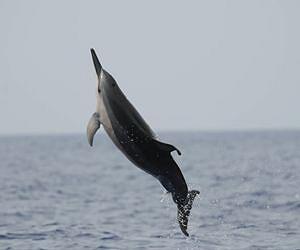
Spinners are small dolphins famed for their graceful aerial movements and balletic spins. Found in tropical and subtropical oceans around the world, coastal populations of the animals divide their time between daytime rest periods in shallow, protected bays and nighttime foraging in more exposed waters.
Distinguishing between sightings of resting and active dolphins was key to defining critical habitats, Thorne said, because while socially active spinner dolphins are more tolerant of humans' presence, resting dolphins will leave the safety of a bay and retreat to less suitable open waters if they are repeatedly interrupted.
"Sleep is essential for most animals," added Johnston. "When deprived of their necessary 'zzzz's,' they gradually show a decreased ability to process information and remain attentive to environmental stimuli. In technical lingo, we call this a 'vigilance decrement'."
Spinner dolphins are no exception to the rule, he said. Over time, dolphins that are harassed by people daily during rest periods will never fully recover their vigilance decrement, and their ability to forage successfully and detect the presence of nearby predators will be degraded. Their ability to produce sounds used for communication and navigation may also be impaired.
Scientists and conservationists have long worried that spinners' popularity with tourists – and overlap of their resting habitats with popular ocean recreation destinations – may be placing them at risk. Reports of interactions have increased sharply in recent years, but few published studies have examined the detrimental impacts these interruptions may have on the animals, especially at the population level.
"It would be next to impossible to survey spinner populations and human activities in every bay that might be a resting habitat. We're talking about hundreds of bays in the Hawaiian islands alone," said Thorne.
"Using predictive models, such as the maximum entropy spatial modeling approaches we've produced, is a much more cost-effective method," she said. "This type of modeling has only recently been applied to the study of marine mammals, but our work suggests it may be especially useful for studies (where data is) derived from opportunistic sightings and surveys using different types of research platforms."
Thorne and Johnston plan to test their models by conducting similar studies of spinner dolphin distributions and habitat use in the Northwestern Hawaiian Islands and elsewhere in the Pacific islands region. Results from those studies, they said, could confirm the new models' usefulness.
