
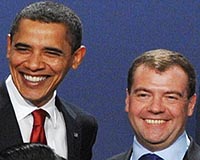
The United States and Russia remain on track to sign a nuclear arms reduction treaty by the end of the year, the presidents of both countries have said.
They will also continue to work together in a dialogue with Iran for more open international inspections of the country's nuclear program.
Negotiators from both countries "have made excellent progress" over the past several months on the proposed START treaty, Obama said at the wrap-up of the Asia Pacific Economic Cooperation summit on Sunday.
"Our goal continues to be to complete the negotiations and to be able to sign a deal before the end of the year," said Obama after a one-to-one meeting with Russian President Dmitry Medvedev. "I'm confident that if we work hard and with a sense of urgency about it that we should be able to get that done. I very much feel as if both sides are trying to work through some difficult technical issues but are doing so in good faith."
The two leaders had met in July in Moscow where they agreed to reduce the number of nuclear warheads that each country could possess to between 1,500 and 1,675 within seven years.
Obama also said they had discussed the issue of Iran's nuclear program and stressed the belief that the United States and Russia could offer a way that allows Iran to develop peaceful nuclear energy. But he also said the Iranians must understand the need to meet their international obligation to disclose nuclear development activity.
"These concerns were further heightened with the Qom facility that had not been properly disclosed," he said.
"We have continued to consult closely with the Russians in terms of providing Iran a very concrete, specific, and fair proposal for some confidence-building measures including a proposal to get low-enriched uranium out of Iran, processed, and then sent back to Iran — to display their ability essentially to have peaceful nuclear energy without weaponization capacity."
Medvedev, speaking through a translator, said the START treaty was greatly important to Russia. He and Obama had "agreed to give additional impetus to those negotiations" to iron out any final problems and "to finalize the text of the document by December."
Medvedev also said that he wanted to see a peaceful resolution to the issue of Iran's nuclear program. "In this case, our goal is clear: it is a transparent, up-to-date, peaceful program and not a program that would raise questions or concerns from the international community. We're prepared to work further and I hope that our joint work will yield positive results."
Obama also became the first U.S. president to attend a meeting with leaders of the Association of Southeast Asian Nations, held during the APEC summit. The meeting included a senior representative from Myanmar, formerly Burma, a member of ASEAN.
Obama's attendance at the ASEAN meeting is considered part of the shifting of U.S. foreign policy towards more dialogue with the state, something that ASEAN leaders have been insisting is the only way to persuade Myanmar's military junta not to renege on promised elections next year.
Indonesia is to host the 21st APEC summit in 2013.
Obama arrived in Shanghai on Sunday night at the start of an official three-day visit.
Share This Article With Planet Earth
