
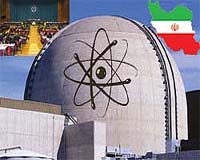
President-elect Barack Obama said Iran's nuclear quest was one of his "biggest challenges" but, vowing respect for the Islamic republic, promised a swift shift from confrontation to diplomacy.
"I think that Iran is going to be one of our biggest challenges," he said in an ABC News interview broadcast Sunday, warning a nuclear-armed Iran "could potentially trigger a nuclear arms race in the Middle East."
Obama promised "a new emphasis on respect and a new emphasis on being willing to talk, but also a clarity about what our bottom lines are."
"And we are in preparations for that. We anticipate that we're going to have to move swiftly in that area."
Former US defense secretary William Perry predicted Thursday that Obama would likely face a "serious crisis" over Iran's nuclear ambitions in his first year in office.
The Islamic republic has defied UN sanctions designed to halt its enrichment of uranium, insisting that its nuclear program is for civilian energy needs and has no military bent.
Obama said he would also confront Iran about its "exporting terrorism through Hamas, through Hezbollah."
"And we are going to have to take a new approach. And I've outlined my belief that engagement is the place to start. That the international community is going to be taking cues from us in how we want to approach Iran," he said.
Obama said his administration would be "sending a signal that we respect the aspirations of the Iranian people," but would also make clear that it has "certain expectations in terms of how an international actor behaves."
Obama's offer of direct talks represents a break with three decades of US-Iranian estrangement, which has sharpened with allegations by President George W. Bush's administration of Iranian support for extremists in Iraq.
Despite his overtures, last month Obama was accused of "cowboy" talk by Iran's conservative parliamentary speaker Ali Larijani for describing a nuclear-armed Iran as "unacceptable."
According to a New York Times report Sunday, Bush last year rejected a secret Israeli request for an air strike using US bunker-busting bombs against the main Iranian nuclear complex at Natanz.
But citing unidentified senior US and foreign officials, the newspaper said Bush had authorized a new covert operation aimed at sabotaging Iran's suspected effort to develop nuclear weapons.
It said top US officials led by Defense Secretary Robert Gates, who is staying on in the Obama administration, had persuaded Bush that any overt attack on Iran would prove ineffective, lead to the expulsion of international inspectors and drive Iran's nuclear program deeper underground.
However, Bush opted for renewed US efforts to penetrate Iran's nuclear supply chain abroad, undermine the country's electrical and computer systems as well as other networks on which Iran relies, the New York Times wrote.
Another report by the Washington Post said Iran was successfully using front companies based in the Gulf region and Asia to import US technology that can have military uses.
The report said the banned items include circuit boards, software and Global Positioning System devices that are used to make sophisticated versions of the improvised explosive devices, or IEDs, deployed to kill US troops in Iraq.
