
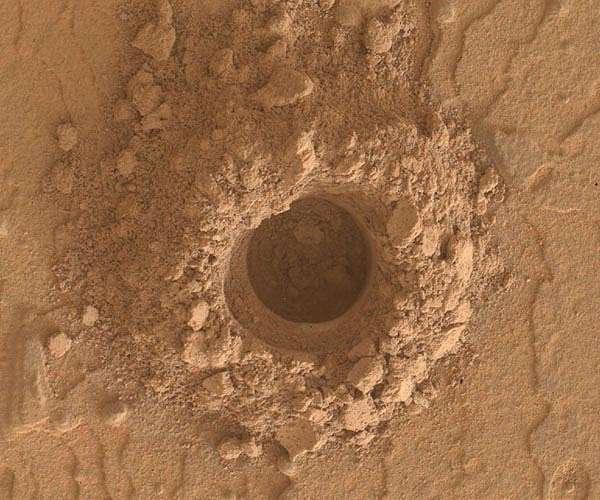
Curiosity is focused on wrapping up the drill campaign at the Canaima site before hitting the road again. Curiosity started out with an unexpected 10% surplus in energy known as a "power gift." This two-sol plan will allow Curiosity to complete the Canaima drilling activities before driving away along the Mount Sharp Ascent Route (MSAR).
One planned activity is to analyze the Canaima drill tailings, the pile of material that was excavated by the drill hole. ChemCam will analyze the drill tailings to compare the chemistry between the drill tailings and the drill hole.
ChemCam will target the range of material that is visible in the tailings pile from the smooth, finer-grained material to the larger clods. MAHLI will image the drill cuttings for context with a single 5cm standoff image. APXS and MAHLI will team up on the target "Bacabal," located on the same rock as the Canaima drill site, to provide more information and context on the bedrock.
Mastcam will acquire stereo imaging of two new targets, "Pedra" (an unusual shiny float rock) and "Taxi" (cyclically bounded laminations in the rock near Canaima), in addition to taking images of the rover wheel tracks to look for changes relative to previously acquired images. ChemCam plans to use its long distance remote micro imager to re-image a nearby hill that contains a distinct marker band, and the rover will continue its usual environmental monitoring.
Sols 3623-3625: RAGE Against the Drill Fines
by Abigail Fraeman | Planetary Geologist – JPL
We are nearing the end of our drill campaign activities at Canaima, and this weekend we are planning to analyze the drilled sample with the SAM instrument's gas chromatograph and mass spectrometer (GC-MS).
Like the CheMin X-ray diffraction and SAM Evolved Gas Analysis experiments, the SAM GC-MS analysis will provide additional data about the rock's composition. GC-MS in particular is great at showing the types of organic molecules that might be present.
Since this is the last time we need to deliver drilled sample to our onboard "chemistry lab instruments," we'll also attempt to dump sample material that remains in the drill bit assembly onto the ground.
In order to preserve the life of the braking mechanisms on Curiosity's arm, the engineering team at JPL developed a new technique for dumping samples that is gentler on the arm (no percussion) with the charming acronym of RAGE, or "Rotate to Agitate Granules for Expulsion." So we'll be RAGEing on Mars this weekend in between all of the science.
With the power-hungry SAM activities, we're only planning a short amount of time for additional science. We'll collect ChemCam observations on two nearby rocks named "Manaus" and "Garimpo Cascavel," as well as a Mastcam multispectral observation of "Dress Island" and stereo mosaic of a nearby rock named "Peluca." ChemCam long distance RMI mosaics of Orinoco and several environmental science monitoring observations will round out the plan.
