
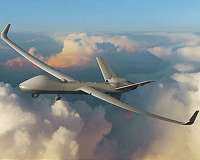
A Predator B/MQ-9 Reaper Block 5 drone has demonstrated the successful use of a radar warning receiver for conducting missions in hostile environments.
General Atomics Aeronautical Systems Inc., maker of the unmanned aerial system, said the tests were conducted recently in California against various ground-based radars using Raytheon's Raytheon ALR-69A RWR.
"The successful demonstration of a mature radar warning receiver on our company-owned Predator B clearly shows the utility of the aircraft in conducting missions in the proximity of threat radars and enemy air defenses," Claudio Pereida, executive vice president, GA-ASI Mission Systems, said in a press release. "We are pleased to be the first company to demonstrate this capability on a remotely piloted aircraft and hope to make it available to interested customers on a quick-reaction basis."
The company said Raytheon's ALR-69A RWR was carried within the Predator B's payload pod and provided enhanced situational awareness by identifying potential radar threats to ground-based crew.
"The ALR-69A provides improved detection range and accurate, unambiguous identification in dense signal environments," said Paul Overstreet, ALR-69A program manager, Raytheon. "Its open architecture is what allows it to operate on manned or unmanned aircraft."
Additional test demonstrations are planned. Included in future company-funded demonstrations will include the aircraft flying with an integrated Link 16 data link.
Whiteflies provide insight into stabilizing manmade drones during takeoff
When whiteflies take off, they don't just spread their wings and fly. Just .03 of an inch long, these tiny insects possess a variety of sophisticated techniques that provide them with exceptional stability in the air. Tel Aviv University researchers now say that they may hold the secret to stabilizing the take-off of small robotic manmade flyers such as miniaturized drones.
TAU research pr … read more
