
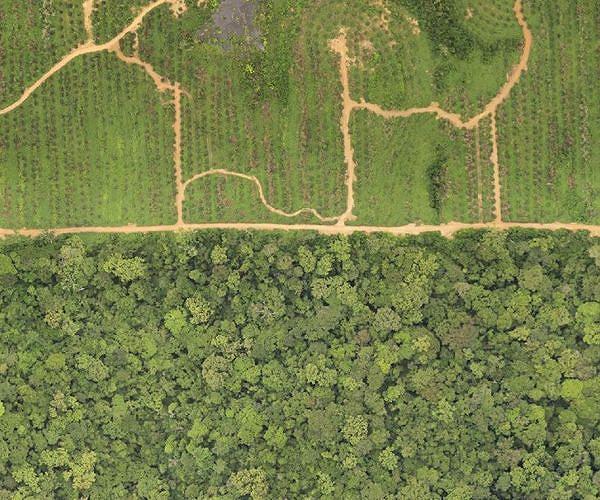
The dense tropical rainforest of Central Africa occupies more than 500 million acres, making it the second largest in the world.
The belt of moist broadleaf forests hosts hundreds of millions of trees and some of the planet's most biodiverse ecosystems. Like most tropical forests, the Congolian rainforest faces a variety of threats, including human development and climate change.
According to a new study, published Wednesday in the journal Nature, some regions of the Congolian rainforest are more vulnerable than others — environmental threats and ecological vulnerabilities are unevenly distributed.
With the help of forestry managers and records from logging companies, researchers catalogued more than 6 million trees spread across 185,000 plots of land. The massive dataset helped scientists map abundance and distribution of tree species across Central Africa.
A better understanding of a forest's composition can help scientists more accurately predict how different parts of the forest will be impacted by climate change — knowledge that can help policy makers craft more targeted protections.
"The forest area of Central Africa is far from being a homogeneous green carpet," first author Maxime Réjou-Méchain said in a press release.
"It is home to a wide variety of forests with different characteristics, including their own particular carbon storage capacity," said Réjou-Méchain, an ecologist at the French National Research Institute for Sustainable Development.
More than just trees, the Congo Basin is hope to some 10,000 plant species, more than a third of which are found nowhere else on the planet.
The region's habitat shelters forest elephants, chimpanzees, bonobos and lowland and mountain gorillas, in addition to hundreds of other mammal species.
Thousands of bird species either live in or pass through the Congolian rainforest, and the region's rivers host hundreds of fish species.
"This diversity can be explained by the different types of climate — humidity, temperature, evapotranspiration rate, amount of rainfall — and soils, as well as by the history of the African flora and the degree of human activity that has disturbed the forests for thousands of years, such as shifting agriculture," Réjou-Méchain said.
The latest analysis determined forests along the northern and southern borders of the Central African rainforest are more vulnerable to climate change, as are those along the Atlantic Coast and within the Democratic Republic of Congo, home to more than half the Congolian rainforest.
Scientists have made the data compiled for their research publicly available.
Researchers said they hope other scientists will mine the dataset for insights into the region's biodiversity and vulnerabilities.
"These results must now be used and applied to develop land use plans that preserve forest characteristics while maintaining connections between protected zones through sustainably managed timber production forests," said co-author Sylvie Gourlet-Fleury.
"In places where human pressure is too great, managers could re-establish these connections through biodiversity restoration programs or the development of agroforestry," said Gourlet-Fleury, a forest ecologist at CIRAD.
Inventory pinpoints the most climate-vulnerable African forests
Paris (AFP) April 21, 2021 –
Huge areas of African forest are highly vulnerable to climate change and man-made activity, according to the most detailed inventory yet of the second largest contiguous forest area on Earth.
The rainforests of central Africa store more carbon per hectare than the Amazon and have a higher density of large trees than anywhere else.
They are a crucial carbon sink but are under threat in several countries due to logging, over-hunting and ever-growing road infrastructure, as well as climate change.
French researchers wanted to identify specific areas of forest that are the most vulnerable to future changes in a bid to prioritise preservation efforts.
They analysed data of six million trees from more than 180,000 field plots spread across Cameroon, Gabon, Central African Republic, Republic of the Congo and Democratic Republic of the Congo (DRC).
Incorporating forest inventory data from 105 logging operations, the team produced computer models to simulate a range of future scenarios and their impact on tree cover.
They identified 10 main types of forest. The models showed that areas of northern and southern forest margins, forests on the Atlantic and most DRC forests are "highly vulnerable" to climate change and man-made activity by 2085.
Maxime Rejou-Mechain, an ecologist at France's Institute of Research and Development, said the study highlighted how diversity in African forests meant some were better suited to facing future threats than others.
"This diversity is due to different types of climate, soils, by the history of African flora but also by the rise of human activities that have disturbed forests for millenia," he said.
The study, published in the journal Nature, found the 15 percent of African forest under official protection doesn't cover all forest types.
Sylvie Gourlet-Fleury, a forest ecologist at the CIRAD research institute and a study co-author, said the research could help governments prioritise specific areas to protect.
"Where pressure from human activity is too strong, managers could re-establish connections between zones thanks to programmes to restore biodiversity," she said.
Writing in a linked comment article, Marion Pfeifer, from Newcastle University's School of Natural and Environmental Sciences, and Deo Shirima, from Tanzania's Sokoine University of Agriculture, said governments needed to cooperate in order to preserve the continent's forested regions.
"Perhaps most crucially, rainforests in Central Africa and the ecosystem services they provide are intertwined with people's livelihoods and food security," they said.
"Developing sustainable management plants that recognise the diversity of ways in which people depend on these forests… will require efforts that move beyond national boundaries."
