
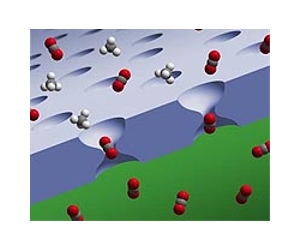
Porous crystals whose nanoscopic pores create large amounts of surface area promise to be excellent materials for natural gas storage, U.S. researchers say.
Now Northwestern University researchers say they've developed a computational method to help scientists find the best possible structure for such crystals, knows as metal-organic frameworks.
The computational algorithm automatically generates and tests hypothetical MOFs, rapidly zeroing in on the most promising structures that can then be synthesized and tested in the lab, a university release reported Tuesday.
"Currently, researchers choose to create new materials based on their imagining how the atomic structures might look," Northwestern researcher Christopher E. Wilmer, who developed the algorithm, said. "The algorithm greatly accelerates this process by carrying out such 'thought experiments' on supercomputers."
In just 72 hours, the researchers generated more than 137,000 hypothetical MOF structures then narrowed that number down to the 300 most promising candidates for high-pressure, room-temperature methane storage.
"When our understanding of materials synthesis approaches the point where we are able to make almost any material, the question arises: Which materials should we synthesize?" Northwestern chemical engineer Randall Q. Snurr said.
The algorithm presents "a powerful method for answering this question for metal-organic frameworks, a new class of highly versatile materials," he said.
