
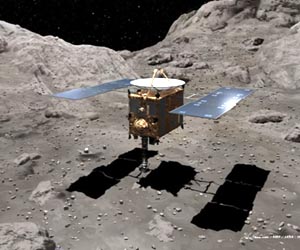
The recent recovery of Japan's never-say-die Hayabusa spacecraft has amazed the general public. It's also helped to ensure that there will be a Hayabusa 2 mission in the future, despite problems elsewhere in Japan's space program. This is good news.
Hayabusa had more than its fair share of troubles, but managed to demonstrate how effectively most of the spacecraft was engineered. The mission of Hayabusa 1 and its planned successor is also essential. We need to understand more about the makeup of asteroids for scientific, engineering and possibly defensive reasons.
But Hayabusa was disappointing in one major field. The principal goal of the mission was sample retrieval, and it did not perform well in this regard.
Scientists are painstakingly examining tiny fragments of material inside the sample return capsule, but are still unsure if they represent fragments of the asteroid Itokawa or contamination from Earth. If the fragments came from Itokawa, they will be useful to scientists, and make the sample- return phase of the mission partially successful. But Hayabusa should have collected more than this.
Hayabusa used a unique method for retrieving samples. The spacecraft approached the asteroid and placed an extendable horn on its surface. A small pellet was then fired like a bullet at the surface. Fragments of the asteroid were supposed to be blown off the surface, and be collected inside the horn.
This wasn't very effective. By itself, this is a useful scientific result. The surface of the asteroid was obviously harder to blow apart than engineers had suspected. We can gain from this knowledge in planning future missions.
How, then, should we consider retrieving samples from asteroids in the future? There are plenty of methods, and some will be more effective than others. The type of method used will also vary with the class of asteroid and its composition. It also depends on exactly what you want to extract, and how pristine you want your sample to be.
I will now take this opportunity to explore some alternative sample collection techniques, which could be useful for Hayabusa 2 and other missions to asteroids.
Drill
Low-power drills have been used for sample collection on the Moon, and another will soon be launched to Phobos on the Russian Phobos Grunt mission. This is the most straightforward means of extracting a sample. Unfortunately, drills require a solid anchor to work from, due to the torque they produce. A spacecraft will need to be anchored securely to the surface of the body, which isn't always possible! This is one reason why this technique would not have been useful on Hayabusa 1.
Wipes
A coarse surface, such as woven cloth, can be used to wipe the surface of an asteroid. It is almost certain that such an action would pick up dust, and possibly some small rock fragments. The cloth could be placed on the end of an extendible rod, and could even be made to wiggle or rotate. This technique could have been used on Hayabusa 1, allowing the spacecraft to sample the asteroid without landing.
Ropes
Similar in effect to wiping the asteroid with cloth, a rough rope or cable would be fired or dragged across the surface of the asteroid. Loose material would be collected in pores or scoops. Later, the rope could simply be winched onto a spool inside a sample-return capsule.
Electrostatic Attraction
Electrical fields could be used to physically attract small particles to an electrically charged plate on the spacecraft. Beams of charged particles fired from the spacecraft could be aimed at the surface of the asteroid to help give them the required charge. Afterwards, a blade could be used to wipe the particles off the electrically charged plate.
Magnetic Attraction
Some material on the surface could be attracted to magnets. A permanent magnet, or an electromagnet, could be placed on the surface. Permanent magnets could then be wiped clean to collect the samples.
Gas
Jets of gas, possibly from the spacecraft's own thrusters, could be used to dislodge dust and small particles from the surface. A small funnel could cover a small patch of soil, blow it clean with gas, and collect the dust with pads on its interior.
Adhesive
Some types of lubricants can remain "sticky" in the vacuum of space. Simply placing a sticky surface on the asteroid could trap small particles. Adhesive could be used in tandem with some of the other contact methods proposed in this article.
Rasp
A rough surface, like a sander or grinder, would touch the surface of the asteroid and physically grind small fragments from its outer surface. If the surface area was small, the torque on the spacecraft could be kept to a minimum. The spacecraft itself could counteract the torque of the rasp with momentum wheels or thrusters.
Claw
Some samples will be retrievable by small robotic claws that seal like clamshells when closed. This will require fine, granular material. Claws could be fired from a distance on cables, then reeled back into a spacecraft.
Mighty Blow
Never mind the BB-gun style approach to dislodging rock that was used by Hayabusa 1. Increase the caliber to a mortar-style round, then fly through the debris cloud. This technique carries risks. The asteroid could easily absorb the impact without throwing up much debris. The spacecraft itself could also be damaged by dislodged material.
Share This Article With Planet Earth
