
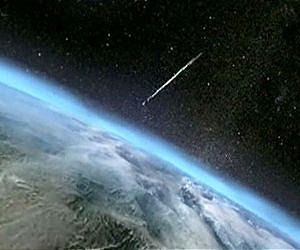
Asteroid defense is an objective that requires multifarious resources, and the Federal Space Agency (Roscosmos) should not be alone in dealing with it, Roscosmos head Oleg Ostapenko said.
"This mission can be accomplished only if we use the entire potential of our country. Everyone has one's own capacities. We will tackle this problem together. By the way, we are working jointly with the Russian Academy of Sciences. We have made an appointment with Vladimir Fortov," Ostapenko said.
The media said an asteroid would fly past the Earth 19 years from now and the planet could be jeopardized.
"We may be interacting in these fields as well. This is an interesting subject," Ostapenko said.
The astronomers of the Crimean Astrophysical Observatory have discovered a 400-metre asteroid that may hit the Earth in 2032.
The minor planet, indexed 2013 TV135, was discovered on the sky of stars imagery by the Crimean Observatory on the 12th of this month. The discovery was later confirmed by Russian observatories in the Buryat Republic, in Siberia, as well as by Italian, British and Spanish astronomers, according to the RIA-Novosti news agency.
The celestial body measuring some 410 metres has been classified as a potentially hazardous asteroid (PHA), since the minimal distance between its orbit and the orbit of the Earth makes up 0.012 of the astronomical unit (1.7 million kilometres). Asteroids are seen as potentially hazardous if the PHA value is less than 0.05.
Besides, the preliminary trajectory measurements have shown that the probability that the asteroid may hit the Earth on August 26th, 2032, is 1/63,000. The probability is high enough to put the asteroid in class one on the Torino Impact Hazard Scale, which is the lowest rank meaning we're running almost no risk, yet the risk is higher than zero.
Of the prominent asteroids, there is another one, 2007 VK184, which has also been ranked 1 on the Torino Scale. If the asteroid 2013 TV135 does hit the Earth, the force of the explosion is estimated to make up 2,500 megatons of TNT.
Source: Voice of Russia
