
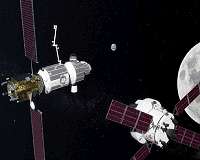
Russia's Roscosmos state space corporation and NASA will work on the concept of a lunar orbital station that may be built with the fully-fledged participation of Russia, Roscosmos head Dmitry Rogozin said on Monday.
"Today NASA is highly interested in the full-fledged Russian participation [in development of a lunar station], and I hope that together we will shape the full architecture of the future lunar mission," Rogozin said at a press conference held at the Rossiya Segodnya Information Agency media centre.
He also noted that a new Angara heavy-class carrier rocket was viewed as "a future core transport system to the Moon."
At the end of September 2017, in the framework of the astronautical congress in Adelaide, Australia, Roscosmos and NASA signed a joint statement, which reflects the partners' intention to work together to implement initiatives in space exploration. It is about planning the creation of a visited station in the near-moon space.
On Roscosmos Projects
Talking about the projects of the corporation, Rogozin also noted that Roscosmos is ready to build a KAZSAT-2R for Kazakhstan and launch it.
"Building this spacecraft is not just a technological issue, this depends on the point on the orbit that is registered to Russia, so we offer a package deal to our partners. We are ready to build this spacecraft, launch it via our launch systems and allow it to work at that point on the orbit… We do not exclude working with our colleagues from Airbus who can supply the necessary technological equipment. This could be done in cooperation," Rogozin told reporters.
He added that Russia would fulfil its obligations to send an astronaut from the United Arab Emirates to the International Space Station in 2019 despite the delay, caused by the Soyuz-FG rocket incident in October.
On ISS Hole Incident
The head of the corporation also addressed the issue of the air leak at the Soyuz MS-09 spacecraft.
"We have never accused the Americans, that never happened. That was a dirty interpretation of some publications in the media. We categorically refute these allegations," Rogozin said.
According to the official, a production defect on the crashed Soyuz-FG rocket was likely accidental.
"[Those responsible] will be determined by the bodies that are in charge of that… [The production defect] was likely accidental," Rogozin said at a press conference held at the Rossiya Segodnya Information Agency media center in Moscow.
On August 30, the crew of the International Space Station (ISS) detected an insignificant air leak, caused by a microfracture on a wall of the living section of the Soyuz MS-09 spacecraft, docked to the ISS. The hole was patched on the same day to restore the hermetic integrity of the ISS.
On Soyuz Crash Investigation
The official also commented, NASA conducted an independent probe into the accident.
"Our colleagues have shown mathematical models of the October 11 situation… US colleagues, since the crew was mixed, carried out an independent investigation as well," he stated.
According to Rogozin, a production defect on the crashed Soyuz-FG rocket was likely accidental.
"[Those responsible] will be determined by the bodies that are in charge of that… [The production defect] was likely accidental," he added.
An accident occurred minutes after the liftoff of a Soyuz-FG launch vehicle carrying the Soyuz MS-10 spacecraft with two new members of the International Space Station (ISS) crew on board, a US astronaut and a Russian cosmonaut. An emergency escape capsule allowed the crew to return to Earth safely.
Russian Cosmonauts Expected to Land on Moon After 2030
Russian cosmonauts will carry out a 14-day lunar landing mission after 2030, according to a presentation made by Russia's general designer of manned spacecraft Yevgeny Mikrin has stated.
"The first landing mission [14 days]," one of the slides in his presentation at a conference dedicated to the 20th anniversary of the International Space Station (ISS) says.
According to the image on the slide, it is planned to send three cosmonauts to the lunar surface.
Mikrin has presented a concept of Russian lunar orbital station.
"We propose that the base block of the station should be created in accordance with the composition of the current Russian segment of the ISS, and include a node module, a scientific/ energy module, and a propulsion module," Mikrin said.
On Russian Segment on ISS
The construction of the Russian segment of the International Space Station (ISS) is scheduled for completion in 2022, Russia's general designer of manned spacecraft Yevgeny Mikrin noted.
"By 2022, we are planning to complete the construction of the Russian segment of the ISS by incorporating three new modules into its structure," Mikrin said.
The Nauka Multipurpose Laboratory Module (MLM) is expected to be installed in 2019. The Prichal node module will be sent to the ISS in 2020, while the Scientific and Energy Module (NEM) is planned to be attached to the orbital outpost in 2022.
The presentation of the Road Map for the Implementation of the Lunar Program showed that the first crews will land on the lunar surface from the lunar orbital station visited.
It is planned to be created on the basis of developments in the Russian segment of the ISS. The timing indicated the creation of the station in the period from 2030 to 2035.
According to the slide presentation, the first landing of astronauts is designed for a 14-day stay on the surface of the moon.
