
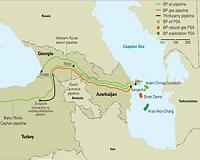
Russian energy company Gazprom is moving forward with developments of a gas pipeline through Turkey with shallow-water preparations, a spokesperson said.
Russian energy company Gazprom said construction of a pipeline known variably as TurkStream or Turkish Stream started in May. Sergei Kupriyanov, a spokesman for the energy company, told Russia news agency Tass progress is still in the preliminary stage.
"Only preparations are underway in shallow waters now," he said.
The pipeline's route would mirror the now-abandoned South Stream project and run under the Black Sea to Turkey and then to the European market. South Stream was scrapped because of concerns about Russian business practices expressed by some European countries.
Turkey, meanwhile, aims to capitalize on its geographic position by becoming an energy bridge between Central Asian and Middle East suppliers and the European market. Geopolitical concerns stemming from Turkey's proximity to the fight against the Islamic State as well as democratization could get in the way of Ankara's ambitions.
British Minister for Europe Alan Duncan said his government was concerned by the ongoing detention of the Turkish director for Amnesty International, Idel Eser, and five others rounded up last week on terrorism charges.
"We continue to urge the Turkish authorities to uphold international standards with regard to the rule of law," he said in a statement.
Leaders in the European Union have expressed concerns over the expanding powers of Turkish President Tayyip Erdogan. Tensions could get in the way of Turkey's ambitions to eventually join the European Union.
Similar geopolitical issues are highlighted by regional tensions in Ukraine, through which Russia sends most of its gas to Europe. Trade between Russia and Turkey, meanwhile, declined by 32 percent to $15.8 billion last year.
Gazprom said the first leg of the pipeline would primarily feed the Turkish market, with the second leg expected for southern European demand. The company in December approved a three-and-a-half-year loan to aid the construction of the planned pipeline.
Spilt crude oil has repeatedly polluted and even destroyed marine ecosystems. An effective measure would be to remove spilt oil slicks by absorption into a separable solid phase. As Indian scientists now report in the journal Angewandte Chemie, congelation of the oil to a rigid gel within impregnated cellulose and scooping the particles out is possible.
Marine oil spills are disasters that … read more
