
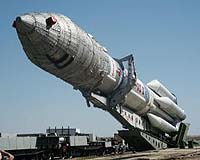
A Russian Proton-M booster rocket carrying a Japanese communications satellite exploded shortly after lift-off early Thursday, a space agency spokesman said. The rocket, which was launched from the Baikonur space center in Kazakhstan at 2:43 a.m. Moscow time (10:43 p.m. GMT Wednesday), experienced an engine malfunction and second-stage separation failure 139 seconds into its flight, and came down in the central Kazakh steppe, 50 kilometers (30 miles) southeast of the town of Dzhezkazgan, the spokesman said.
The rocket was carrying highly toxic heptyl rocket fuel, and an investigative team will soon be sent to determine the extent of any environmental damage that may have resulted from the crash, he said.
Although Russia and Kazakhstan have an agreement on launches from Baikonur until 2050, for which Moscow pays Astana $115 million a year, Kazakhstan recently said it would reconsider allowing further flights of the Proton because of the rocket fuel's toxicity and potential for catastrophic environmental contamination in the event of a launch failure.
The satellite was owned by JSat Corp. and would have provided communications links for Japan, the Pacific Region and Hawaii. The company currently operates eight geostationary communications satellites.
The Delaware-registered company International Launch Services (ILS), which organized the launch, is a Russian-American joint venture that has orbited 41 commercial payloads since 1996.
Last year, a Russian Dnepr rocket crashed on lift-off from Baikonur, after which a special commission was formed to assess the resulting environmental damage. On the basis of its findings, Russia paid Kazakhstan $1.1 million in damages.
related report
Crashed Proton-M rocket was insured for $300 million
A proton-M rocket with a Japanese communications satellite on board that crashed shortly after launch early Thursday was insured for $300 million, an insurance company spokesman said.
"We are the insurers for this launch with regard to any liabilities before third parties," Vyacheslav Shabalin of the Russian Insurance Center said. "Our representative is on the investigating commission, and once the circumstances of the crash have been determined, we will be prepared to make all the necessary payments."
He said the company has many years of experience insuring space missions and of compensating the costs of failed launches, including the loss of a Dnepr rocket in 2006, which he said was "paid for in full."
The Proton-M, which was launched from the Baikonur space center in Kazakhstan at 2:43 a.m. Moscow time (10:43 p.m. GMT Wednesday), experienced an engine malfunction and second-stage separation failure 139 seconds into its flight, and came down in the central Kazakh steppe, 50 kilometers (30 miles) southeast of the town of Dzhezkazgan, the spokesman said.
Possible environmental contamination from the booster's highly toxic fuel is a particular concern, and a team has been sent to the crash site to determine the extent of any pollution.
Source: RIA Novosti
