
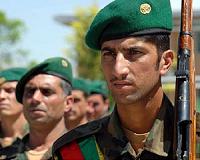
The Special Inspector General for Afghan Reconstruction has released its quarterly report, painting a picture of military stalemate, heavy Afghan casualties, worsening security, and a severe lack of oversight on billions in U.S. spending.
The report details SIGARs concerns that U.S. personnel are adopting a siege mentality and are unable to provide oversight to billions in reconstruction and security spending.
"Common sense has always dictated that a balance needs to be struck between the need for risk mitigation and the need for U.S. organizations, such as USAID, DEA, Department of Justice, SIGAR, the Government Accountability Office, and others, to accomplish their missions," the report said.
"Hunkering down behind blast walls while positive from a security perspective, damages not only the U.S. civilian mission but also handicaps the U.S. military mission to create a stable and functioning Afghan military and police free from corruption and incompetence."
Further details revealed in the report show worsening fighting with rising casualties among Afghan security forces, with over 2,500 killed in action and thousands more wounded since January.
More than 12,000 Afghan Ministry of Defense personnel are unaccounted for, with an unknown number of them so-called "ghosts" that draw pay but do not report for duty.
Opium cultivation continues to rise despite $8.6 billion allocated for its eradication since 2002, with more than 772 square miles under cultivation. Less than 0.5 percent of last years opium crop is believed to have been eradicated, and opium is estimated to account for over three-quarters of Afghanistan's agricultural sector.
More than $714 billion has been spent on Afghanistan operations since the 2001 U.S. invasion, with approximately $119.7 billion having been spent on reconstruction and relief efforts. Rampant corruption and inefficiency has hobbled many of the efforts to make Afghanistan's civil government and military self-sustaining, analysts say.
SIGARs report states that the only way to combat rampant corruption and wasteful spending on U.S. sponsored projects is rigorous oversight and engagement in the field, and that being too risk-averse made this impossible.
"Ironically, in the long run, such extreme risk aversion and avoidance may even contribute to greater insecurity, since it limits U.S. diplomatic reach to the very Afghan agencies, officials, and community leaders necessary to foster stability, rule of law, and economic growth, while sending an unintended but dangerous message to friend and foe alike that the terrorists should be feared and may actually be winning," SIGAR said in the report.
US watchdog files report on Afghanistan child abuse
A US government watchdog has filed a secret report to Congress into allegations of child sex abuse by the Afghan security forces – and the extent to which America holds them accountable.
According to the office of the Special Inspector General for Afghanistan Reconstruction (SIGAR), which on Tuesday announced it had sent the classified findings to lawmakers, Afghan officials are failing to … read more
