
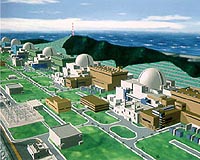
South Korea's president offered Monday to help energy-hungry India build more nuclear plants as the two Asian powerhouses set a goal of doubling bilateral trade by 2014.
President Lee Myung-bak touted what he said was his nation's expertise in building nuclear power stations as he expressed hope that South Korean companies would help India to construct new atomic power plants.
Lee said South Korea, which recently won a 20.4-billion-dollar deal to design, build and operate four nuclear power plants in the United Arab Emirates, has displayed its competitiveness in the nuclear field.
"This is a very productive area to collaborate for mutual benefit," he told business leaders in the national capital.
India now gets less than three percent of its energy needs from nuclear power. But the country aims to increase that amount to as much as 50 percent by 2050, according to India's Atomic Energy Commission
South Korea was a key supporter of New Delhi in its recent successful bid to have a more than three-decade embargo on the export and sale of nuclear technology to India lifted.
Lee, who is on a four-day visit, added that a far-reaching trade pact which came into effect at the start of the year would put relations on to a new trajectory.
The Comprehensive Economic Partnership Agreement between South Korea and India which scraps or reduces most trade tariffs heralds a "great new era" for the two countries, said Lee.
In a joint statement, the two countries declared a goal of increasing bilateral trade to 30 billion dollars by 2014. Trade has already increased more than five-fold to 15.6 billion dollars from three billion in 2002.
The president, who was accompanied by a high-powered political and business delegation, was slated to be chief guest at India's Republic Day national celebrations Tuesday.
Indian Trade Minister Anand Sharma said New Delhi was hoping for greater Asian economic integration to make the 21st century "Asia's century" and the trade deal with South Korea would help to reach that goal.
He said South Korea could also play a big role in improving India's dilapidated infrastructure, noting the country aimed to spend 1.5 trillion dollars on improving its ports, highways and other facilities in the coming 10 years.
Despite the upbeat tone of the visit, the most high-profile South Korean investment in India remains mired in controversy.
Steel giant Posco's plan to start work on a 12-billion-dollar plant in eastern India is still three years behind schedule.
The plant represents one of the largest planned foreign investments in India and is part of Posco's strategy to source cheaper raw materials.
The plant has been delayed by poor farmers who say their land is being gobbled up unfairly in a row that has cast a cloud over India's efforts to woo foreign investors and spur economic growth.
The South Korean president pressed the Indian government to clear the way for the plant's construction.
Indian Steel Minister Virbhadra Singh pledged to try to speed up the process.
"Efforts are on to see the entire matter is signed and delivered in the next four to five months," Singh told reporters.
He made the commitment after receiving a delegation from Posco, headed by the company's chairman, Joon-Yang Chung.
Singh said once clearances were given, production could start in two years.
"It was a very fruitful meeting," the Posco chairman said.
Share This Article With Planet Earth
