
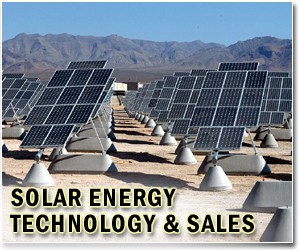
A Nobel Prize-winning U.S. scientist says the world could soon enter an era where renewable wind and solar power will be the globe's main sources of energy.
Walter Kohn, who shared the 1998 Nobel Prize in Chemistry, told a meeting of the American Chemical Society that total oil and natural gas production, which today provides about 60 percent of global energy consumption, is expected to peak about 10 to 30 years from now, followed by a rapid decline, an ACS release said Tuesday.
But ongoing research and development of alternative energy could lead to a new era in human history in which two renewable sources — solar and wind — will become Earth's dominant contributors of energy, Kohn said.
Global photovoltaic energy production increased by a factor of about 90 and wind energy by a factor of about 10 over the last 10 years, Kohn said, and he expects vigorous growth of these two effectively inexhaustible energies to continue.
Kohn, from the University of California, Santa Barbara, cited students on his campus who spent their own funds to convert an athletic building to total solar power.
"When it comes to providing leadership by young people in the area of energy conservation and energy efficiency and global warming — they are fantastic," he said. "It is a major social commitment for our times."
earlier related report
Study: Energy self-sufficiency is closer
Boston (UPI) Aug 23, 2010 –
U.S. scientists say they've made a discovery that could bring the era of energy self-sufficient homes and small businesses one step closer.
Scientists at the annual meeting of the American Chemical Society have reported the discovery of a powerful catalyst that would be a key element in inexpensive solar energy systems that could free homes and businesses from dependence on the electric company, a society release said Monday.
"Our goal is to make each home its own power station," study leader Daniel Nocera said. "We're working toward development of 'personalized' energy units that can be manufactured, distributed and installed inexpensively.
"There certainly are major obstacles to be overcome — existing fuel cells and solar cells must be improved, for instance. Nevertheless, one can envision villages in India and Africa not long from now purchasing an affordable basic system."
Such systems would use solar panels to generate electricity needed for heating, lighting and cooking during the day. Surplus energy created would be stored in an "electrolyzer" which breaks ordinary water down into hydrogen and oxygen, which would be stored in tanks.
At night, with no energy coming from solar panels, the system would feed the hydrogen and oxygen back into fuel cells that produce electricity.
The newly discovered catalyst can boost the output of the electrolyzer 200-fold, researchers say.
The catalyst has been licensed to a company, Sun Catalytix, which says it is working to develop safe, super-efficient versions of the electrolyzer, suitable for homes and small businesses, within two years.
Share This Article With Planet Earth
