
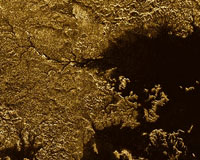
Fluid erosion has carved river networks in at least three bodies in our solar system in the form of water on Earth and Mars and liquid hydrocarbons on Titan. A new report in Science examines the global drainage patterns of these worlds to shed light on their geologic past.
Titan's landscapes look similar to Earth's in many ways. But is this similarity only superficial? Scientists from CUNY, MIT, and other institutions have found that the origins of topography on Titan – and Mars – are quite different from on Earth. River networks give us a window into the history of each world.
Most topography on Earth is the result of plate tectonics, which builds mountain ranges that jut up and shunt aside rivers as they flow towards the oceans.
No one knows for sure what built the topography on Titan, but the scientists discovered that the rivers there have not suffered similar diversions as on Earth. This provides evidence that the history of topography on Titan is more like that of Mars, which did not have plate tectonics, and where the largest scale topography was set very early after Mars' formation.
Dr. Benjamin Black, lead author and Assistant Professor of Earth and Atmospheric Science at City College and of Earth and Environmental Sciences at The Graduate Center, City University of New York (CUNY), and his team used mapping, analysis of spacecraft data, and numerical modeling to glean clues from river networks.
"What we can see of Titan's surface looks tantalizingly familiar, at least at first glance. But we know very little about Titan's past," said Dr. Black.
"On Earth, the upheaval of plate tectonics diverts rivers. When we compared river patterns on Earth with those on Mars and Titan, we found substantial differences, suggesting Mars and Titan grow their topography in distinctly un-Earth-like fashion. You could say that the history of each world is written in its rivers."
Since the validation of plate-tectonic theory in the 1960s, researchers have wondered what Earth's surface would look like if our planet did not have plate tectonics.
"One of the exciting things about this study is that it provides evidence that Earth's topography is quantitatively different from that of Mars and Titan, two planetary bodies without plate tectonics," said Dr. Ken Ferrier, Assistant Professor of Earth and Atmospheric Sciences at Georgia Tech.
"This evidence is encoded in river channel networks, which the authors suggest harbor a heretofore unrecognized signature of plate tectonics."
Dr. Black and his colleagues suggest that the river networks of Earth, Mars, and Titan could serve as a Rosetta stone to help scientists decode the impact of tectonics on topography.
History of Titan's Landscape Resembles Mars's, not Earth's
The environment on Titan, Saturn's largest moon, may seem surprisingly familiar: Clouds condense and rain down on the surface, feeding rivers that flow into oceans and lakes. Outside of Earth, Titan is the only other planetary body in the solar system with actively flowing rivers, though they're fed by liquid methane instead of water. Long ago, Mars also hosted rivers, which scoured valleys acro … read more
