
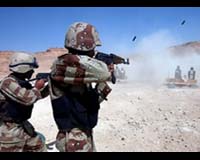
Photo courtesy of AFP. On the outskirts of Iraq's ethnically divided northern oil hub of Kirkuk, US army Lieutenant Christopher McElrath was winding up a training session with local police when it became apparent a little extra instruction was needed.
Sergeant Jamari Hood, one of McElrath's troops in the 3rd Battalion, 82nd Field Artillery Regiment, was forced to take a moment to give an Iraqi police officer pointers on just how to hold his gun.
McElrath was dealing with a new reality faced by many of the roughly 130,000 US troops in Iraq since they pulled back from urban areas at the end of June.
Where once US troops were on the frontline of the fight against insurgents in Iraq, now the emphasis is on training Iraqi security forces.
"We try to get the training agenda from them … we take what they ask for, and then we make suggestions," McElrath told AFP outside a police station on Kirkuk's outskirts.
The 750,000-odd members of the Iraqi police and army, who are now fully responsible for security in the country's cities, have been praised by US commanders for the progress they have made.
But during training sessions in Kirkuk, many seemed unschooled in some fundamentals.
"They've all gone through the basic level, but a lot of the times they don't have the opportunity to do the day-to-day training," said Captain Tyler Donnell, who helps train police in the north of the city.
"Everything we've learned is through straight repetition. That's what we're trying to get the police to do as well. … They have the skills but there is a lot of brushing up that needs to occur."
American training includes how to clear a room of threats, weapons maintenance and police ethics.
Keeping the peace in Kirkuk — which has a mixed population of Arabs, Kurds and Turkmen — is seen as key test for the Iraqi security forces.
— We need more support —
————————–
Longstanding Kurdish demands to incorporate the province in their autonomous region in the north are bitterly opposed by the city's Arab population — many of whom were settled in the city as a deliberate act of government policy under Saddam Hussein's regime to dilute its historical Kurdish majority.
Insurgents have sought to play on the ethnic tensions, making the city one of Iraq's tensest despite an overall drop in violence this year.
The number of violent deaths fell by a third last month to 275 from 437 in June. The figure for May was 155, the lowest of any month since the US-led 2003 invasion.
Kirkuk's provincial police chief conceded his officers "need more" training.
"We need this support from training, it's a very big issue for us," Major General Jamal Taher Bakr told AFP, estimating that his force was at around 70 percent readiness.
"It's not just one thing — it's weapons, investigations" and how best to ensure that communities feel secure, said Bakr, a Kurd.
"The coalition support us with the training, and until 2011, they will keep supporting us," he added, referring to the deadline for the complete withdrawal of US forces set by a security pact signed by Baghdad and Washington last November.
"But we need more support… you know, we need more."
Major Ian Palmer, from the 4th Squadron, 9th US Cavalry Regiment, said it was important to keep perspective and not compare Iraq's security forces with their better equipped American counterparts.
Palmer, who is responsible for training in southern and eastern Kirkuk, said he thought the province's police and military were the best in Iraq, but it was important not to "spread too much hyperbole".
"You try to take the perspective of, can they effectively secure their responsible areas? And the answer to that is yes.
"You've got to take an objective view of the Iraqi army and what their charter is and what they're being asked to do and what's important to them, versus comparing them to your own units.
"We're better equipped, better paid … You don't want to make those comparisons, it's just not beneficial."
But with time running out on the US troop presence in Iraq, the depth of their task is evident in McElrath's class.
As the US lieutenant chatted with Iraqi police after training, Sergeant Hood was at the other end of the room, teaching an officer to move in smooth, controlled steps — and not lunge — as he moves in on an enemy.
Share This Article With Planet Earth
