
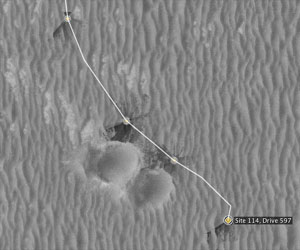
After taking some time to recharge her batteries, the rover attempted a drive on Sol 2202 (April 4, 2010). That drive stopped after the initial arc turn due to elevated current draw in the motors on the right side of the rover. The rover is between two ripples with the space in between forming a bowl.
The rover had to push harder on the right to make the sharp turn. Conservatively-set current limits stopped the drive, as a way for controllers on the ground to assess the driving conditions before proceeding.
With everything looking okay, another drive on Sol 2204 (April 6, 2010), was commanded. It too began with a short, sharp arc. This time the drive stopped after a short distance because of wheel slip exceeding the limit of 40 percent.
Again ground controllers assessed the conditions and found no problems. With these sharp turns, the rover's wheels must impart more thrust. When the wheel thrust exceeds the shear strength of the terrain, slip occurs.
Opportunity will drive again on Sol 2206 (April 8, 2010). This time the rover is already aligned with the drive direction, so no sharp turns are needed.
Extra slip checks will be performed to make sure there are no terrain issues. As of Sol 2204 (April 6, 2010), the solar array energy production was 235 watt-hours with an atmospheric opacity (tau) of 0.371 (from Sol 2199) and a dust factor of 0.500.
Total odometry is 20,247.56 meters (20.25 kilometers, or 12.58 miles).
Share This Article With Planet Earth
