
Blizzards in the United States, a heatwave in Brazil, killer floods in Mexico, drought in Ecuador — according to meteorological services, freak weather being felt right across the Americas can be blamed on El Nino.
The phenomenon, in which unusually hot surface temperatures along the middle of the Pacific Ocean disrupt atmospheric systems, has created storms throughout the continent and resulted in several emergencies being declared.
Thus, New York and Washington residents were hunkering down under a mountain of snow that closed schools, federal government offices and the UN headquarters. Flights into New York were also disrupted.
In sharp contrast, at the other end of the continent, Rio de Janeiro was sweating under its worst heatwave in 50 years, with temperatures soaring higher than those found in the Sahara desert, according to Brazil's Inmet weather service.
On Tuesday, in fact, the 46.3 degrees Celsius (115 degrees Fahrenheit) recorded in Rio was unsurpassed worldwide, except in the town of Ada in eastern Ghana which came in two degrees higher, according to data from the World Meteorological Organization.
Thirty-two elderly residents in the southern Brazilian city of Santos died Monday and Tuesday from the heatwave, the municipal health service told AFP. There were no immediate reports of deaths from the heat in Rio.
Deadly floods were the El Nino fallout for several other regions on the continent.
Brazil's Sao Paulo state, neighboring Rio de Janeiro, has had nearly two months of rains that have killed more than 70 people.
Mexico has dug 42 bodies out of flood-hit homes in its west as unexpected rains struck half the country. A temporary collapse of Mexico City's drainage system and overflowing sewage triggered emergency measures.
Another 10 people have died in Bolivia, where a deluge also affected 22,000 families and large tracts of farmland.
In Peru, authorities were grappling with flooding that cut off its famed Machu Picchu Incan ruins, forcing the evacuation by air late last month of 2,200 tourists stranded there.
In Argentina, a state of emergency was declared in Buenos Aires as fears mounted that the big Parana river was about to break its banks.
On the equator, the problem was too little, not too much, water.
Ecuador was suffering its worst drought in 40 years. Venezuela, faced with similar low water levels in its main hydroelectric plant, was put under an "electricity emergency" Monday by President Hugo Chavez.
Brazil's Weather Forecasting and Climatic Studies Center said El Nino would continue to affect the country to the end of March notably by imposing dry conditions on the north.
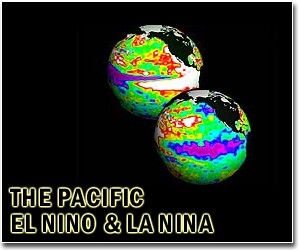
The US government's National Oceanic and Atmospheric Administration posted a thermographic image of El Nino on its website, showing a mass of red representing high ocean temperatures across the Pacific, from Australia to Central America.
Klaus Wolter, a climatologist at the University of Colorado, told AFP last week that the heavy snow storms in the United States — nicknamed "Snowmaggeddon" then "Snoverkill" by the media there — were likely exacerbated by the phenomenon.
"There are at least two players in this game: El Nino and what the North Atlantic is doing," Wolter said, explaining that the ocean on the other side of the Americas influenced the arctic temperatures in Europe.
Share This Article With Planet Earth
