
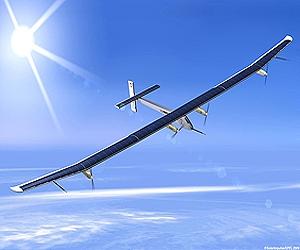
The Solar Impulse aircraft, which made history Thursday with the first round the clock flight using energy from drawn the sun, boasts cutting edge technology from ultra efficient electronics to lightweight materials.
It is been dubbed the "zero fuel aircraft" by the team, which claims the plane has "the wingspan of a jumbo jet, the weight of a car and the power of a scooter."
The final design of the Swiss-made aircraft emerged in 2007 and it was built a year later by Solar Impulse engineers, with the backing of sponsors in the electronics, engineering, aerospace and solar energy industries, as well as one of Switzerland's top technical universities.
The primary aim was to save energy and build a lightweight yet extremely strong craft that was also able to resist the huge temperature variations involved in modern flying in a matter of minutes or hours.
The beige and silver grey prototype, registered HB-SIA, was largely made out of composite materials and complex alloys, to marry the wing span of a Airbus A340 intercontinental airliner with a weight of just 1,600 kilogrammes.
The 12,000 ultra thin solar cells, spread over a wing area equivalent to 200 square metres, fed a 400 kilogramme load of lithium polymer batteries, which have still not reached mass production electric cars.
Each of the four electric motors produced up to ten horsepower – six kilowatts — each barely more than the one that helped the Wright Brothers to make history in 1903 by hopping off the ground on the first powered flight.
The 3.5-metre long propellors also rotated noticeably slowly compared to a traditional propellor engined aircraft.
Some of the control systems were specially made, including a highly precise instrument to measure the smallest change in tilt of the aircraft, which was made by a watchmaking group, according to Solar Impulse.
The instrument was also rigged up to the sleeves of a flight jacket to alert the pilot to any excessive change.
Pilot Andre Borschberg said the seven years of planning, design, construction and refinement of the aircraft had helped yield about 50 developments on materials technology for one supplier.
The batteries were also improved, he added, in some instances by bringing separate industrial partners and suppliers together in the project.
"The second airplane will be even more performing with lighter, thinner solar cells and more efficient systems," said Solar Impulse chief Bertrand Piccard, also promising more stretching room for the pilot.
Key dates of sun-powered Solar Impulse plane project
Geneva (AFP) July 8, 2010 –
Key dates of Solar Impulse, a solar-powered flight project masterminded by Swiss adventurer Bertrand Piccard, which made history Thursday as the first manned plane to fly around the clock on energy from the sun:
22 May 2007: Bertrand Piccard unveils Solar Impulse after four years of planning. The project sets its sights on crossing the Atlantic Ocean, before making a round-the-world tour, powered by the sun.
26 June 2009: Inauguration of the solar-powered plane prototype at the military aerodome in northern Switzerland's Duebendorf airbase.
7 April 2010: Solar Impulse completes its first flight lasting 1.5 hours
7 July 2010: Solar Impulse takes off in the early morning from western Switzerland's Payerne for a non-stop flight through day and night, piloted by Andre Borschberg.
8 July 2010: Solar Impulse lands safely after a flight of 26 hours and nine minutes, having reached a maximum altitude of 8,564 metres above sea level during the flight.
2011: Longer missions lasting several days and nights with the current aircraft, HB-SIA, expected.
Until 2012: Designing and building a new, bigger plane, HB-SIB, which would have more cockpit space to allow the pilot to stretch out. It will also be better suited to longer journeys and have improved technology, as it would be lighter, more efficient, and have thinner solar cells.
2013-2014: Attempts at transatlantic and round the world flights in HB-SIB.
Share This Article With Planet Earth
