
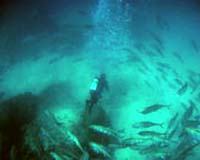
Angola, Namibia and South Africa launched a joint commission Friday designed to lay the groundwork for a sustainable and environmental approach of their shared fishing grounds in the Atlantic Ocean. "The Benguela Current Commission (BCC) is the first of its kind in the world," said Namibia's fisheries minister Abraham Iyambo at the opening of the new body in the Namibian capital Windhoek.
"Our countries now jointly tackle responsible fishing, management of shared fish stocks and environmental problems like pollution, and mitigation of impacts from marine diamond mining, oil and gas production," Iyambo added. The BCC will also concentrate and scientific research on marine life.
The three countries agreed to establish the BCC at a meeting in Cape Town last August, with support and funding from the United Nations Development Programme, Germany and Norway.
It derives its name from the cold, but nutrient-rich Benguela current from the Antarctic flowing along the coast of the three countries. UNDP country coordinator Simon Nhongo said the UN's Global Environment Facility would contribute around five million dollars to set up a secretariat.
According to South Africa's Environment Minister Marthinus van Schalkwyk, marine fish resources worldwide are declining.
"We have to carefully manage our shared fish stocks in order to harvest them sustainably," he said at the opening of the conference.
A recent study on the fishing sector along the Benguela current found that some 33,850 sea birds are killed each year by pelagic and demersal longline fishing, 4,200 sea turtles and some 6,6 million sharks.
earlier related report
ICoast president warns of disappearing forests
Abidjan (AFP) July 21 – Ivory Coast's president, Laurent Gbagbo, has condemned the exploitation of the west African nation's tropical forests, which are disappearing at a rate of about 300,000 hectares (741,000 acres) annually, media reported Saturday.
Speaking in his home village of Mama to mark the annual "day of the tree" on Friday, Gbagbo warned: "Between 200,000 and 300,000 hectares of forest disappear every year because of human activities."
According to press reports, the president also accused government ministers of failing to abide by laws designed to protect the country's forests.
"A minister was even seen hunting (in the biggest park in the country) in the full knowledge that it was banned by the government," he said.
Ivorian Environment Minister Daniel Aka Ahizi urged Ivorians to help fight deforestation by planting trees themselves.
"Through this tree-planting project, the national day of the tree aims to increase the forest by at least 100,000 hectares with trees that would belong to individuals, village communities and morally-minded people," he said.
However, two environmental groups are boycotting this year's event, arguing that it should be held in an area where the effects of deforestation were more stark than in Mama, a western village situated in the forest.
"We would have preferred that the event take place in a more barren area than Mama, preferably in the north where the desert is fast advancing," Jacob N'Zi, head of the Ecological Group of Ivory Coast (Geci), told AFP.
Official figures show the size of Ivory Coast's tropical forests has shrunk from 16 million hectares in the 1960s to no more than six million now.
But N'Zi argues that this number could be as low as one million hectares, part of which is occupied by the western Tai national park, a UNESCO heritage site protected with aid from the German government.
In June, forest workers staged a week-long strike to protest against the "anarchic exploitation" of Ivory Coast's national parks.
Source: Agence France-Presse
