
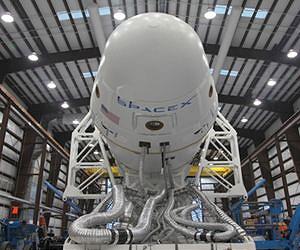
Cooper Interconnect has announced that Space Exploration Technologies (SpaceX) utilized Cooper Interconnect non-explosive actuators on the Dragon Spacecraft to support the mission to become the first commercial vehicle in history to attach to the International Space Station. Non-explosive actuators enable containment and release of hardware during different phases of a space mission.
Typical spacecraft applications include deployment of covers to expose docking collars, unfolding of antenna and solar-power arrays, and opening parachutes.
The Dragon launched on May 22nd; attached to the International Space Station on May 25th; and splashed down in the Pacific Ocean on May 31st. The Dragon spacecraft is comprised of three main elements: a nose cone, a pressurized capsule, and an unpressurized cargo trunk.
The non-explosive actuators were installed on the Dragon capsule to facilitate a broad range of mission-critical functionality including nose-cone deployment needed to expose the docking adapter, release of the trunk before re-entry into the atmosphere, opening of the main-parachute door before splashdown and for the contingency flight release of the grapple fixture that was not required in this mission.
"Cooper Interconnect is proud to have attained a 100 percent success rate with our non-explosive actuators during the historic mission to dock the first commercial spacecraft to the International Space Station," said Peter Milstead, Cooper Interconnect's director of marketing for military and aerospace products.
"This challenging technical feat is especially impressive as it has previously only been accomplished with the government resources of the United States, Russia, Japan, and the European Space Agency."
Non-Explosive Actuator (NEA) solutions provided by Cooper Interconnect include: bypass switches, cable releases, pin pullers, separation nuts, tension releases, and flight-termination systems. For more information, please visit www.cooperinterconnect.com.
