
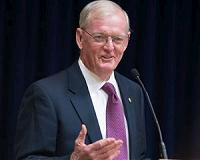
Legendary Johnson Space Center icon Glynn Lunney, a flight director during the Gemini and Apollo Programs and best known for his work with Apollo 13, talked about the early days of the space program and his contributions to it to a packed house at the Gilruth Center recently.
His "Highways into Space" lecture, based on his new autobiography, was hosted by the SAIC/Safety and Mission Assurance speaker forum, kicking off the fifth year of monthly forums aimed at knowledge sharing.
Defining strong leadership was a running theme throughout the lecture, with Lunney citing the teams that worked during the new frontier of spaceflight as naturals. "They did it (lead) every day, but no one talked about it," Lunney said.
He said that writing his autobiography was a very reflective time for him, allowing him to digest the events he had experienced through storytelling. "The more I worked on the book, the more I appreciated the leadership I was exposed to," Lunney added.
To Lunney, a good leader is one who is always able to capture the right choices and stay ahead of the curve. "If you were to draw or write an equation, the management must provide leadership and trust."
Lunney, who received a long list of awards throughout his career, including Medal of Freedom for his efforts with Apollo 13, began his career in 1958 with the National Advisory Committee for Aeronautics and Space Task Group, later supporting Project Mercury in mission control as a Flight Dynamics Officer. In 1964, he became a flight director and later worked as a technical director for the Apollo/Soyuz Test Project and manager of the Space Shuttle Program.
He told those in the crowded Gilruth ballroom that in the beginning of the space program, everything was a mystery and so new that the team "had to figure almost everything out."
Lunney told a story about an unmanned Mercury Redstone rocket that lifted off the launch pad only a few inches before it settled back into place, creating a huge risk to those on the ground because it was still filled with propellant. "Everyone thought it lifted off, but there it was, still sitting on the pad," Lunney said.
The big question for NASA engineers became what to do about it. Someone even suggested the team shoot holes in the rocket with a high-powered rifle to drain the propellant. After much debate, it was decided to wait overnight until the battery depleted. Rescued, the rocket did fly on another try about two months later.
"What that got me to thinking was I had a one-dimensional view," Lunney said. "I was simple minded through the way I was thinking about these things." It was an eye-opening experience for Lunney.
When President John F. Kennedy announced the United States' goal to reach the moon within a decade, Lunney was a young man building his career. He said he "was stunned to think of going to the moon," because he knew that it would be "100 times more difficult than what we were doing."
"It was really staggering to me that the president would decide to do that," Lunney said.
However, Lunney said that he and his colleague-who he described as "kind of an emotional gang" that would get "rowdy about what we were doing"-liked to push big ideas on a grand scheme, and so they did just that. He admits that, at the time, he was not cautiously aware of the future. He was instead completely in the moment and felt "in the presence of something powerful, but I never applied language to it."
During the infancy of space exploration, Lunney said that many of the team were young and hired right out of college. He said the quality management looked for most was … attitude.
"No one had to come around and jack us up with a speech," Lunney said, adding that there was also an element of trust that created an obligation to the team, because they expected one another to do the job well. "I'm happy to tell my story about what the leadership did (in the early days of space exploration) and who they were."
