
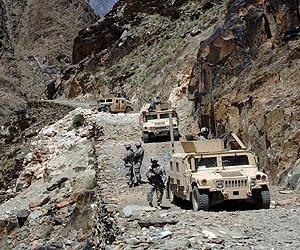
Keeping the convoy "left of the boom" is the single-minded focus of Sergeant 1st Class Tom as the Dutch patrol snakes through the desolate mountains of Afghanistan's Uruzgan province.
The sergeant and his team of six engineers are the last line of defence against the roadside bombs that have become the biggest killers of coalition troops in the Afghan war.
It takes four hours to cover less than 10 kilometres (six miles) from forward operating base Mirwais to an "overwatch" point on a small plateau above a river valley through which the troops will patrol on foot.
At choke points, where the terrain forces vehicles to take a particular line across the barren, mountainous moonscape, engineers walk ahead of the vehicles, mine-detectors sweeping every inch of the trail.
"But most important are the eyes — your gut feeling and your sight," says Sergeant Tom, identified only by his first name in line with Dutch military procedure. "It's a cat and mouse game. We have to stay left of the boom".
"Left of the boom" is a military term for the period before a device explodes, as in a timeline written across a page where the story starts with the network of facilitators and leads to the man planting the bomb.
To the right of the boom is too late for anyone in the vicinity — 11 Afghan troops and policemen died in two separate blasts in the area two weeks ago.
Many more coalition troops are killed by Improvised Explosive Devices (IEDs) than in direct combat, and last year's death toll was the highest since the US-led invasion ousted the hardline Islamist Taliban regime in 2001.
A US intelligence officer said recently that up to 90 percent of casualties among foreign forces were caused by IEDs.
"Over the years the threat has changed," the commander of Dutch forces in Uruzgan, Brigadier General Marc van Uhm, told AFP in an interview.
"In 2007 for example there were many fights on a daily basis. Now, the Taliban has learnt that when they are engaging my troops they will not win.
"So what they do is fight against us indirectly, by using IEDs, suiciders and that's of course more difficult for us."
Having reached its overwatch point safely, the Dutch patrol sets off on an intelligence-gathering operation, essential to gauging mood and movement that might point to hostility to coalition troops — and plans to kill them.
Two thin lines of soldiers make their way down a steep, rocky mountainside towards "the green" alongside the river, into a village of medieval mud-walled compounds, some turreted like the forts of times long past.
In stark contrast to the vast emptiness beyond the reach of the water, there is suddenly life among groves of almond trees: men and children, sheep, cattle, donkeys and chickens — but no women visible outside the high walls of the compounds.
The patrol is soon confronted by a turbanned, white-bearded elder who is not pleased to see them and not afraid to tell them.
"Why are you coming here?" he asks platoon leader Captain Rik through an army interpreter, as curious children crowd around.
The captain, an affable blond with the build of a rugby player and a sharp glint in his eye, explains that he wants to know if all is well in the village.
"We can solve our own problems," the elder says dismissively. "Here is peace, there is no Taliban."
He says it is "very bad" when troops enter compounds without permission — although Captain Rik's men have not done so — as "there are women".
The patrol moves on and within minutes encounters a sharply contrasting attitude — the captain is invited in for tea in a lavishly-carpeted guest house with a portrait of Afghan President Hamid Karzai on the wall.
The host chats about the need for a better bridge over the river and the fact that the district government is establishing a school in the area.
The central province of Uruzgan is one of Afghanistan's poorest, with high illiteracy among the population of about 360,000.
The captain explains that he is part of the Dutch battle group and is looking for information on Taliban activity but will report the problems to the provincial reconstruction team at Mirwais.
Then a call comes through from the engineers: they have found a cache of explosives. They searched an abandoned compound and found two wrapped and buried anti-personnel mines.
The mines are of the type that, when tripped, spring to about chest height before exploding, invariably killing anyone within range.
But in Afghanistan they could also be used to trigger bigger IEDs, such as those commonly made with ammonium nitrate fertilizer, which can be deadly even to troops in armoured vehicles.
The two mines bring the patrol to a grinding halt. A line of soldiers guards the compound; a line of Afghan men in turbans and flowing robes squats two metres (yards) away across an aqueduct and watches.
Sergeant Tom's men are happy to blow the mines themselves, but battle group headquarters in the provincial capital Tirin Kot says a bomb disposal squad will be flown in by helicopter the next day.
So, having set out on a one-day patrol, the troops prepare to spend the night on the overwatch plateau as the sun sinks behind peaks dusted with snow and shepherds lead their small flocks home.
Just two mines are enough to keep dozens of soldiers and several vehicles marooned on the freezing mountain, turning what should have been an eight hour patrol into a 36-hour operation.
The muezzin's call to prayer floating up from the valley the next morning brings the soldiers to their feet as an icy dawn breaks over jagged mountain ranges, and a new patrol sets off into "the green".
But word finally arrives that the bomb squad cannot make it and Sergeant Tom's men should get rid of the mines. The Afghan civilians, who have gathered again along the aqueduct, are moved away and two powerful blasts soon echo across the valley.
The patrol packs up and winds its achingly slow way back to camp, having stayed "left of the boom", for the moment.
Share This Article With Planet Earth
