
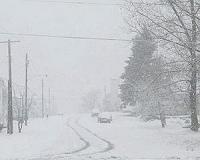
Twenty-one people died over the weekend in Poland because of freezing weather amid one of the country's deadliest cold spells, the government said Monday.
"Twelve people died over the last 24 hours. We also recorded nine other victims the day before," spokeswoman Bozena Wysocka from the government centre for security (RCB) told AFP after temperatures dropped to minus 20 Celsius (minus 4 Fahrenheit) in certain areas.
That brings the total number of deaths linked to the cold weather to 39 since November 1, she added.
Poland's deadliest hypothermia weekend in recent years was December 19-20, 2009, when 42 people died.
Police have called on residents of the European Union country of 38 million to keep an eye out for anyone running the risk of hypothermia, especially the homeless, inebriated or the elderly.
Fourteen people have also died since Christmas in the Polish-Slovak Tatra mountains, with most of the victims slipping and falling to their deaths on the icy slopes.
Poland's cold spell was late to arrive this winter, just like in 2014-2015, when 77 people died of hypothermia, compared to 78 in 2013-2014 and 177 in 2012-2013.
Blizzard kills 15,000 cows in Texas
Chicago (AFP) Jan 4, 2016 – A freak blizzard killed at least 15,000 dairy cows in the US state of Texas and for almost two days kept farmers from milking some of those that survived, officials said Monday.
The brutal winter storm dumped heavy snow on the northern part of Texas on December 26. Farmers have not yet fully assessed the damage.
"They're still trying to dig out, but at least it stopped snowing," Kirsten Voinis, a spokeswoman for the Texas Association of Dairymen, told AFP.
Texas ranchers typically let their cows graze in pastures rather keeping them locked up in barns. The storm hit too suddenly for them to get their cows inside.
The association estimates that the storm killed about ten percent of mature dairy cows in the region. It does not yet have an estimate as to how many calves and heifers were killed.
Safely disposing of the carcasses will be a major challenge.
"We usually send them to rendering, but we're not sure if rendering will be able to handle a number this big," Voinis said.
"We're trying to figure out if there's wintering capacity, or if we do have to bury them. That opens up other issues… water quality and how it impacts your land."
Many of the surviving cows will also likely give less milk for months to come. They are typically milked twice a day, but the bad roads and blowing snow meant farm workers were unable to get some cows into their barns to be milked for as much as two days.
"When a dairy cow goes that long without being milked, her milk supply starts to dry up," Darren Turley, executive director of the Texas Association of Dairymen, said in a statement.
"That means the dairy cows in this region will give less milk for months to come. Less milk going to market will be felt by consumers, as well as by dairy farmers."
