
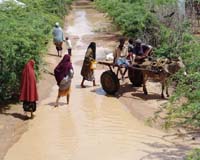
The death toll from floods that have ravaged Sudan over the past fortnight has tripled tp around 100 people since last week, officials said Wednesday. At least another 100 people were injured while some 5,000 homes were destroyed or damaged in the worst flooding to have hit the country since 1988, said a crisis centre cited by Sudan's official SUNA news agency.
Caused by rising waters of the Nile and Gash rivers due to the rainy season, the flooding has inundated large swathes of land in eight out of Sudan's 26 states over the past two weeks.
"The crisis centre thinks that this year's floods will last long, with the average rainfall already having exceeded that of 1946 and 1988," when some 60 people drowned, the agency reported.
The centre said its priority was to provide victims with accommodation, food, medicine and pumps, as well as assist with dyke building.
Working to help them were local authorities and agencies of the United Nations along with neighbouring countries such as Egypt and some Gulf states.
According to a previous assessment announced by the Sudanese interior ministry last week, around 30 people had died in the floods.
earlier related report
Panic as tremors rattle Kenyan capital
Nairobi (AFP) July 18 – Panic rocked the Kenyan capital Wednesday after a series of earth tremors shook high-rise buildings sending office workers fled for safety, witnesses said.
Officials struggled to contain the growing panic as nearly half a dozen skyscrapers were evacuated in Nairobi. Geologists said the tremors that hit Nairobi and several towns in the country resulted from siesmic activities in Oldonyo Lengai (God's Mountain) in northeastern Tanzania.
Oldonyo Lengai, which lies about 250 kilometres (156 miles) southwest of Nairobi, is an active volcano that erupted in 1966 and 1988.
The magnitude of the latest tremors, that have shaken Nairobi since the weekend, ranged from 4.4 and 6.0 on the Richter scale, said Eliud Mathu, head of the University of Nairobi's department of geology.
Government spokesman Alfred Mutua sought to calm the public.
"We should all be diligent and watch out for signs of any earthquake. The government will issue a warning if it receives information of an impending earthquake," Mutua told a live televised press conference.
"Therefore, we should not panic or fan panic. Life should continue as normal," he added.
In December 2005, a powerful earthquake struck the Lake Tanganyika region of East Africa.
That quake, which French geologists said registered 7.5 on the Richter scale and US geologists said was a magnitude 6.8, shook buildings in cities throughout the east and central African region.
Much of eastern African region, including Oldonyo Lengai and Nairobi, lies in the Great Rift Valley, a massive geographical feature created by shifting of tectonic plates and volcanic activities.
Source: Agence France-Presse
