
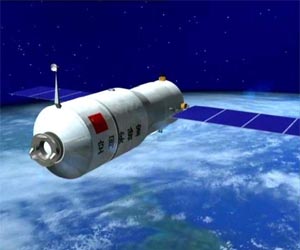
The launch of China's Tiangong 1 space laboratory has finally taken place. Apart from marking the debut of Tiangong as an operational spacecraft, it's worth considering what else we can already learn from this.
Let's start with the launch event itself. China has notched up another successful flight in its Long March 2 launch vehicle series. This improves the overall scorecard for the various engines, stages and sub- systems associated with this family of rockets, which is regularly used for satellite launches.
It also continues a successful return to form for the Chinese space program, which recently experienced the loss of a satellite launch aboard a Long March 2C rocket.
We have also witnessed the debut of the Long March 2F/G launch vehicle, which has fortunately succeeded in its maiden launch. The most obvious difference in this new rocket is a modified payload fairing, designed to accommodate the larger dimensions of the Tiangong spacecraft.
China has also reported dozens of other improvements, but has not been specific about most of them. Some of these are probably minor changes to some parts and sub-systems. They probably make the vehicle easier to build, and more robust.
Could the first launch of the Long March 2F/G also be its last? This is an unresolved question. China is planning yet another upgrade to this system, dubbed the Long March 2F/H. The introduction of the "G" series does not seem to be too different from the original 2F.
By contrast, the "H" series is practically a new launch system. New engines and new propellants are being used. Outside, it probably still looks like a traditional Long March 2F, but its performance should be much improved.
The need for this new souped-up rocket has not been fully explained by Chinese authorities. A realistic theory suggests that more power is needed to lift the next generation of Shenzhou spacecraft, which will carry astronauts to the Tiangong laboratory and a future space station.
The first of this next-generation Shenzhou spacecraft will launch later this year, when Shenzhou 8 is launched to dock with Tiangong without a crew aboard.
That's the next significant issue in this launch. The next series of Shenzhou missions simply couldn't fly without having Tiangong 1 in orbit. All these missions are scheduled to dock with Tiangong.
The launch of this space laboratory now clears the way for Shenzhous 8, 9 and 10. Delays in the launch of Tiangong 1 have caused a backup effect on China's entire human spaceflight program. Now that the launch blockage is cleared, we will hopefully see missions fly at a more rapid pace.
Tiangong's mission has begun, even though no other spacecraft has docked with it. The first task is the check-out phase, as controllers ensure that Tiangong is working properly. For a new spacecraft on its maiden voyage, this is a critical issue. Tiangong also has experiments that can operate automatically. There are two Earth observation cameras on its exterior.
These are probably already returning data. Other experiments could already be functioning inside the laboratory. It's only just begun, but there's a lot more to come. Let's hope we can find out more soon.
