
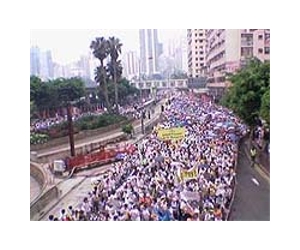
Tens of thousands of Hong Kong residents on Friday marked the bloody 1989 Tiananmen crackdown with a candle-lit vigil, as agitation against Beijing intensifies in the former British colony.
The annual event came after a week of controversy in Hong Kong — thirteen activists were arrested on May 29 after clashing with police in an attempt to erect a "Goddess of Democracy" statue in the Times Square shopping district.
The statue emulated the papier-mache edifice that in 1989 became a symbol of the pro-democracy protests in Beijing's Tiananmen Square, which were crushed by the army at the cost of hundreds, if not thousands, of lives.
In Tokyo, Wu'er Kaixi, one of the best-known student leaders of the Tiananmen protests, was arrested Friday after entering the Chinese embassy.
The Hong Kong vigil, attended by as many as 150,000 people according to organisers, has become a touchstone for a movement calling for democracy in China and for Beijing to reverse its official verdict condemning the demonstrations as a counter-revolutionary uprising.
A sea of people packed the city's Victoria Park holding candles, singing, chanting and listening to music and short speeches calling for an end to the one-party state in China. Some carried flowers and wore stickers emblazoned with a picture of the democracy statue.
"I still remember," 42-year-old Anson Ng told AFP, with tears welling. "I remember the students, I remember the tanks."
Amy Lai, a clerk whocame with her husband, said: "We came to remember Tiananmen Square, of course, but also to support democracy here — that's very important to us."
In central Beijing, black cars marked "special police", each manned with two armed officers wearing helmets and flak jackets, patrolled at regular intervals.
But near the vast square itself, the police presence was far less heavy than for last year's 20th anniversary.
One Beijing taxi driver said he was unaware of the anniversary. "I was 15 at the time but I didn't see much and in the past 21 years no one has really raised the issue," he said, asking not to be named.
"But to be honest, Chinese people don't care about politics, they just care about living."
Hong Kong has a separate legal system from China as part of the deal that returned the former British colony to Chinese rule in 1997 and remains a centre for dissident activity because of its vigorous devotion to free speech.
"This is still a very important event for Hong Kong, China and the world," said Richard Tsoi, vice chairman of the Hong Kong Alliance in Support of Patriotic Democratic Movements in China.
"It sends a message to the Chinese government that people won't forget June 4," he told AFP.
Lee Cheuk-yan, a legislator and head of the Confederation of Trade Unions, said the annual event highlighted the city's own political struggle.
Campaigners in Hong Kong are upset at what they say is Chinese interference in the democratic reform process in the wealthy financial hub, where elections are skewed in favour of pro-Beijing business elites.
"It's not just a matter of June 4 any more," Lee told AFP. "Now it's also a matter of protecting our freedom (in Hong Kong) so we don't become like mainland China."
In the run-up to the anniversary, families of those killed in 1989 grouped under the name "Tiananmen Mothers" demanded that Beijing end its silence and open a dialogue on the bloodshed.
Sculptor Chen Weiming, a New Zealand national who lives in the United States, was deported Wednesday after he tried to enter Hong Kong to inspect the "Goddess of Democracy" statue's condition, according to legislator James To.
Students at the Chinese University of Hong Kong vowed to erect the statue on campus after Friday night's vigil, defying a ban by university administrators.
Share This Article With Planet Earth
