
The global community is gradually moving to ban conventional weapons that are deemed too indiscriminate in their effects to comply with prevailing standards of behavior in wartime.
Weapons such as land mines pose risks for non-combatants that are increasingly viewed as unacceptable by most civilized people. The latest category of weapons to be subjected to global scrutiny is cluster munitions, and multiple treaties are currently pending to proscribe their use.
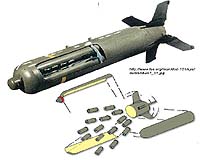
Cluster munitions are bombs or artillery shells that carry many smaller explosive devices called submunitions. These submunitions are designed to disperse across large areas before detonating, so a single cluster bomb can destroy multiple targets. Most cluster munitions cannot detect individual targets, and they often leave target areas strewn with unexploded submunitions that later result in civilian casualties — especially among children.
It is not hard to see why civilized opinion has turned against such weapons, especially given the vast array of alternatives for waging war more humanely. However, past experience has proven that poorly constructed treaties for prohibiting whole categories of weapons can have unintended effects.
For example, a blanket ban on all cluster munitions will not end the desire of military forces to deny use of contested areas to enemies, and therefore might perversely encourage the use of more lethal "unitary" munitions.
The international community therefore needs to think through how armed forces might respond to various approaches aimed at limiting the use of cluster munitions. It currently has two options from which to choose. One option is a treaty drafted pursuant to the so-called Oslo process that would ban any weapons conforming with certain physical characteristics. The other is a U.N. treaty that would focus on specific performance features.
Both treaties would ban more than 99 percent of the cluster munitions in the current U.S. arsenal. However, the Oslo treaty was drafted without the participation of major military powers such as China, India, Russia and the United States, so it is unlikely such countries will become signatories. If they don't, 90 percent of the world's cluster munitions will remain beyond the reach of treaty strictures. The draft U.N. treaty, on the other hand, emerged from a more inclusive process that assures the support of all major military powers.
In addition, the U.N. treaty would permit the use of technologically advanced cluster munitions that minimize danger to civilians by using sensors and computer logic to identify targets. That same technology enables the munitions to quickly self-destruct or become dormant so they pose no long-term danger.
The United States has already promulgated a policy that would restrict its own cluster weapons to those exhibiting such performance features. The Oslo treaty would ban these advanced munitions, thus depriving militaries of a more humane weapon. The U.N. treaty thus represents a better solution to the problem, whereas the Oslo treaty could actually encourage greater carnage in wartime.
(Loren B. Thompson is chief executive officer of the Lexington Institute, an Arlington, Va.-based think tank that supports democracy and the free market.)
