
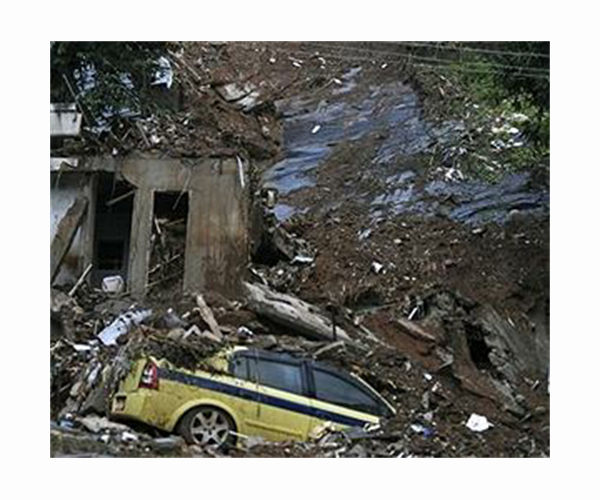
Rescue workers pulled more bodies Saturday from the muddy wreckage left by devastating floods and landslides in the Brazilian city of Petropolis, where the death toll rose to 146, including 26 children.
In a dense fog, workers dug with spades and shovels through the rubble and muck as the search churned through its fifth day with little hope of finding more survivors.
An AFP photographer saw rescuers carrying out two recovered corpses in body bags in the hard-hit neighborhood of Alto da Serra, as relatives sobbed in the street.
In the heart of the disaster zone, rescue workers occasionally blew loud whistles to call for silence and listen for signs of life.
But authorities say there is little hope at this point of finding survivors from Tuesday's torrential rains.
The downpour turned streets to gushing rivers in the picturesque city in the southeastern mountains, and triggered landslides in poor hillside neighborhoods that wiped out virtually everything in their path.
Officials say 24 people have been rescued alive, but that came mostly in the early hours after the tragedy.
Rio de Janeiro state police said 218 people remained missing as of late Friday.
Meanwhile, 91 of the 146 bodies recovered so far have been identified, according to the police.
Many of the missing may be among the unidentified bodies. But the numbers have been hazy, and it is difficult to know how high the death toll could go.
President Jair Bolsonaro, who flew over the disaster zone Friday by helicopter, said the city was suffering from "enormous destruction, like scenes of war."
Tuesday's was the latest in a series of deadly storms to hit Brazil, which experts say are made worse by climate change.
In the past three months, at least 198 people have died in severe rains, mainly in the southeastern state of Sao Paulo and the northeastern state of Bahia, as well as Petropolis.
– 'Little by little' –
Normal life has been slow to return to central Petropolis, a charming tourist town that was the 19th-century summer capital of the Brazilian empire.
Staff were busy cleaning out shops in the city center, where little was open besides essential businesses such as supermarkets and pharmacies.
One bookstore owner had to dump her entire stock of water-logged books in the street.
"They were stocked in the basement. It filled with water all the way up to the ceiling," said Sandra Correa Neto, 52, her thousands of books waiting for the city's overloaded sanitation workers to collect them.
"We're so sad to lose all these books. We can't even donate them, they're too damaged. It pains me," she told AFP.
Elsewhere in the city center, family members cried as rescue workers dug through the ruins of a collapsed house, looking for the mother of a family of four.
The father and two children's bodies had already been recovered.
In the Alto da Serra neighborhood, atop the worst landslide, rescue workers in bright orange uniforms kept up a slow, dogged search alongside exhausted residents looking for their missing loved ones.
Authorities say the mountain of mud and rubble is unstable, so the search is being carried out with hand tools and chainsaws at the hardest-to-reach spots.
It would be too dangerous to bring in the excavators being used in less difficult zones near the bottom of the hillside, said Roberto Amaral, coordinator of the local fire department's special rescue group.
"It's impossible to bring in heavy machinery up here, so we basically have to work like ants, going little by little," he told AFP.
A sobering series of funerals, meanwhile, continued at the city's main cemetery, where 90 victims have been buried so far — 44 on Saturday alone.
Volunteer logistics whizzes race to aid Brazil storm victims
Petropolis, Brazil (AFP) Feb 18, 2022 –
Clothing donations have flooded into Brazil's disaster zone, but underwear is in short supply. Enter the volunteer logistics masterminds racing to find out what those left homeless by this week's deadly storms actually need — and get it to them.
Tuesday's torrential rains and the deadly floods and landslides they triggered have turned the scenic mountain city of Petropolis into what numerous officials, including President Jair Bolsonaro, describe as a "war zone."
Teams of rescue workers are knee-deep in mud and rubble searching for landslide victims, anguished families sobbing for their lost loved ones are an all-too-common sight, and the mangled remains of cars washed away in flash floods are strewn around the city.
Residents like lawyer Daniel Vasconcellos have responded by setting up overnight charities resembling wartime supply operations.
When Vasconcellos and his law partner, Bernardo da Silva Oliveira, saw that authorities and established charities were not getting their neighbors the help they needed, they turned their offices into the headquarters of a massive aid effort.
Outside their offices in the hard-hit neighborhood of Chacara Flora, a long human chain passes packages of bottled water from hand to hand at rapid speed.
Inside, the floor is stacked high with clothing, food, hygiene products, diapers and myriad other necessities for people who lost everything.
"When the landslides hit, we and a lot of others rushed to help people trapped in the mud and rubble," says Vasconcellos, 28.
But once rescue workers and the army arrived at the scene, "we saw people needed another kind of help," he told AFP.
Donations started pouring in from all around Brazil as news of the tragedy spread. But he and Oliveira saw a gap between what people were getting and what they needed.
"The official donation centers are full, but sometimes they're not getting to the people up there in hillside neighborhoods who are waiting for a family member's body to be found," says Vasconcellos.
As natives of the neighborhood, they knew what was needed: motorcycles.
In the poor hillside communities around Petropolis — the scenes of the deadliest landslides — "there are a lot of places where cars can't go, only a motorcycle can get there," says Oliveira, 29.
"We go all the way to the top of the mountain."
– 'We go to them' –
They started with two motorcycles, using social media to spread the word and collect donations from family and friends.
The operation soon snowballed.
As it grew, they sought to do a better job matching donations to people's needs than groups using official channels.
At first, with their electricity and water cut off, residents' most urgent need was bottled water.
Now, they need to change clothes, their babies' diapers and brush their teeth.
"Sometimes people receive a donation and they end up throwing it away," says Vasconcellos.
"We go to them and say, 'What do you need?' If we don't have it, we go to the supermarket and get it."
The biggest needs right now? Baby bottles, milk and underwear, they say.
Father Moises Fragoso de Sousa is heading another massive logistics operation at the Santo Antonio church, which sits in front of Morro da Oficina, sight of the deadliest landslide.
The square outside the church is an anthill of activity, with about 100 volunteers racing to sort and deliver donations for the community and 200 newly homeless people sheltering inside.
"We started with a very improvised structure, but we're getting better organized by the day," says the 35-year-old priest.
"People's volunteer spirit has been incredible to see. It's the biggest labor force in this tragedy."
